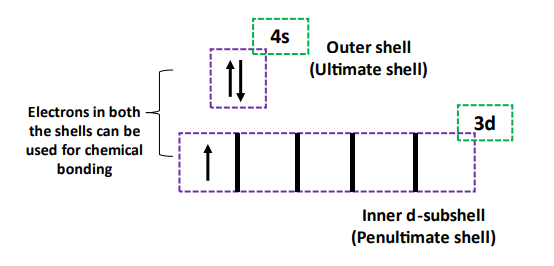
Transition elements generally have valence electrons in both the outer ns orbital and the nearby (n−1)d orbital. For example, iron has the configuration [Ar] 4s2 3d6, so its valence electrons are commonly counted as 8.
For students studying chemistry in the United States, understanding the valence electrons of transition elements is essential for explaining oxidation states, ion formation, bonding, and many of the chemical properties of d-block metals. Unlike main-group elements, transition elements do not always have a simple valence-electron count based only on the outermost energy level.
The key idea is that the ns and (n−1)d orbitals are close in energy. As a result, both sets of electrons can participate in chemical behavior. This is why transition elements such as iron, copper, and manganese can form more than one common oxidation state. Their electron configurations also contain important exceptions, including chromium and copper.
Source: slideserve.com
What Are Valence Electrons in Transition Elements?
Valence electrons are electrons that can participate in chemical bonding and reactions. For main-group elements, valence electrons are usually identified from the highest occupied principal energy level. Transition elements require a broader approach because their ns and (n−1)d orbitals are relatively close in energy.
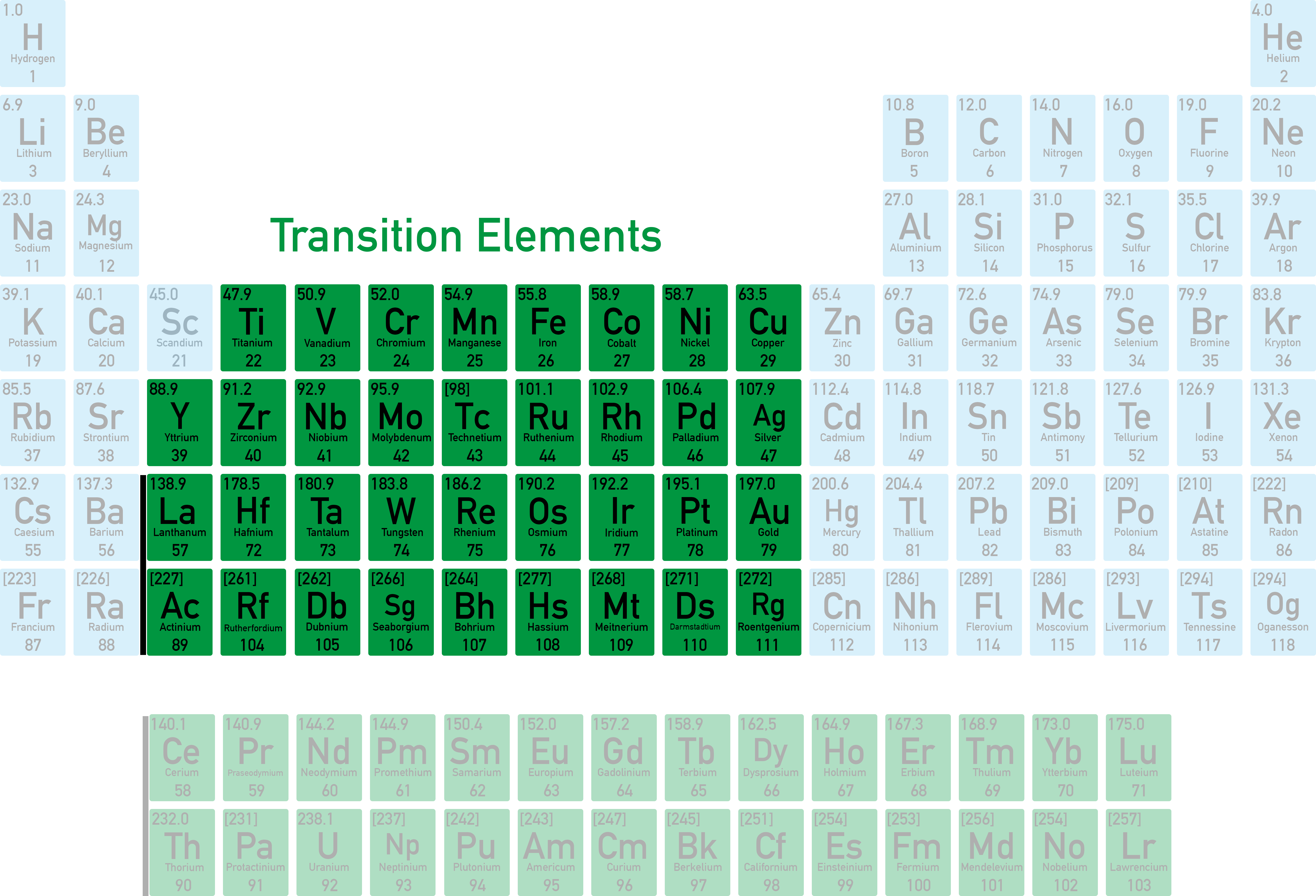
A transition element is generally characterized by a partially filled d subshell in the atom or in one of its common oxidation states. The d-block occupies the central region of the periodic table. The first transition series is associated with the 3d orbitals, the second with the 4d orbitals, and the third with the 5d orbitals.
For many chemistry applications, the valence configuration of a transition element is represented as ns2(n−1)d1 through ns2(n−1)d10, with recognized exceptions. Because both the s and d electrons can be involved in chemical processes, simply counting the outermost-shell electrons can give an incomplete picture.
Source: chemistrystudent.com
Outer ns electrons
These electrons occupy the highest principal energy level and are often involved in ion formation.
(n−1)d electrons
These d electrons are close enough in energy to the ns electrons that they can also participate in bonding and oxidation-reduction chemistry.
Variable participation
Different numbers of s and d electrons may participate depending on the element, ion, compound, and chemical environment.
Why Are Transition Metals Different From Main-Group Elements?
For a main-group element such as sodium, the outermost electron is relatively straightforward to identify because the valence shell follows a clear s- or p-block pattern. Transition elements are different because the d subshell being filled belongs to the principal energy level immediately below the outermost s subshell.
For example, iron has the electron configuration [Ar] 4s2 3d6. If only the highest principal energy level were counted, iron would appear to have two valence electrons. In transition-metal chemistry, however, the six 3d electrons can also be chemically relevant, so the broader valence-electron description includes the 4s and 3d electrons.
How to Find the Valence Electrons of Transition Elements
The most reliable method is to write the electron configuration first and then identify the relevant ns and (n−1)d electrons. This avoids the common mistake of assigning the valence-electron count directly from the periodic-table group number.
For a first-row transition element, the general pattern is [Ar] 4s2 3d1 through [Ar] 4s2 3d10, although chromium and copper have important exceptions. The 4s and 3d subshells are close in energy, so the actual ground-state configurations must be used.
Source: topblogtenz.com
Step 1: Identify the element
Locate the transition element in the d-block and determine its atomic number.
Step 2: Write the electron configuration
Use noble-gas notation when convenient, such as [Ar] 4s2 3d6 for iron.
Step 3: Identify the ns and (n−1)d electrons
For a transition element, examine both the outer ns subshell and the nearby d subshell.
Step 4: Count the relevant electrons
Add the electrons in the ns and (n−1)d subshells when using the broader transition-metal valence-electron definition.
Example: Finding the Valence Electrons of Iron
Iron has atomic number 26. Its ground-state electron configuration is [Ar] 4s2 3d6. The 4s subshell contributes two electrons and the 3d subshell contributes six electrons. Therefore, the broader valence-electron count for neutral iron is eight.
This does not mean iron always uses all eight electrons equally in every chemical reaction. The actual oxidation state and chemical environment determine which electrons are involved.
Valence Electrons of the First-Row Transition Elements
The first transition series runs across the fourth period of the periodic table and involves the 3d subshell. It includes scandium through zinc in the commonly used d-block description. The electron configurations show a gradual filling of the 3d subshell, with chromium and copper providing notable exceptions.
The following table shows the ground-state electron configurations and the broader valence-electron count commonly used when discussing transition-element valence electrons.
Source: knordslearning.com
Scandium
Sc has [Ar] 4s2 3d1, giving three electrons in the ns and (n−1)d subshells.
Titanium
Ti has [Ar] 4s2 3d2, giving four relevant ns and d electrons.
Vanadium
V has [Ar] 4s2 3d3, giving five relevant ns and d electrons.
Chromium
Cr has the exceptional configuration [Ar] 4s1 3d5, giving six relevant ns and d electrons.
Manganese
Mn has [Ar] 4s2 3d5, giving seven relevant ns and d electrons.
Iron
Fe has [Ar] 4s2 3d6, giving eight relevant ns and d electrons.
Cobalt
Co has [Ar] 4s2 3d7, giving nine relevant ns and d electrons.
Nickel
Ni is commonly represented as [Ar] 4s2 3d8 in introductory chemistry treatments, giving ten relevant ns and d electrons under that convention.
Copper
Cu has the exceptional configuration [Ar] 4s1 3d10, giving eleven electrons across the 4s and 3d subshells.
Zinc
Zn has [Ar] 4s2 3d10. Its filled 3d subshell means zinc does not meet the strict definition of a transition element, although it is commonly included in discussions of the d-block.
First-Row Transition Element Electron Configuration Table
The pattern below is useful for studying electron configurations and understanding why transition elements display variable oxidation states.
Sc: [Ar] 4s2 3d1
Three electrons occur in the 4s and 3d subshells.
Ti: [Ar] 4s2 3d2
Four electrons occur in the 4s and 3d subshells.
V: [Ar] 4s2 3d3
Five electrons occur in the 4s and 3d subshells.
Cr: [Ar] 4s1 3d5
Chromium has six electrons across these subshells and is an important configuration exception.
Mn: [Ar] 4s2 3d5
Seven electrons occur in the 4s and 3d subshells.
Fe: [Ar] 4s2 3d6
Eight electrons occur in the 4s and 3d subshells.
Co: [Ar] 4s2 3d7
Nine electrons occur in the 4s and 3d subshells.
Ni: [Ar] 4s2 3d8
This common introductory representation contains ten electrons across the 4s and 3d subshells.
Cu: [Ar] 4s1 3d10
Copper has eleven electrons across the 4s and 3d subshells.
Zn: [Ar] 4s2 3d10
Zinc has twelve electrons across the 4s and 3d subshells, but its d subshell is completely filled.
Why Do Transition Elements Have Variable Oxidation States?
Transition elements commonly show multiple oxidation states because the ns and (n−1)d electrons are relatively close in energy. Losing or sharing different numbers of these electrons can produce ions with different charges.
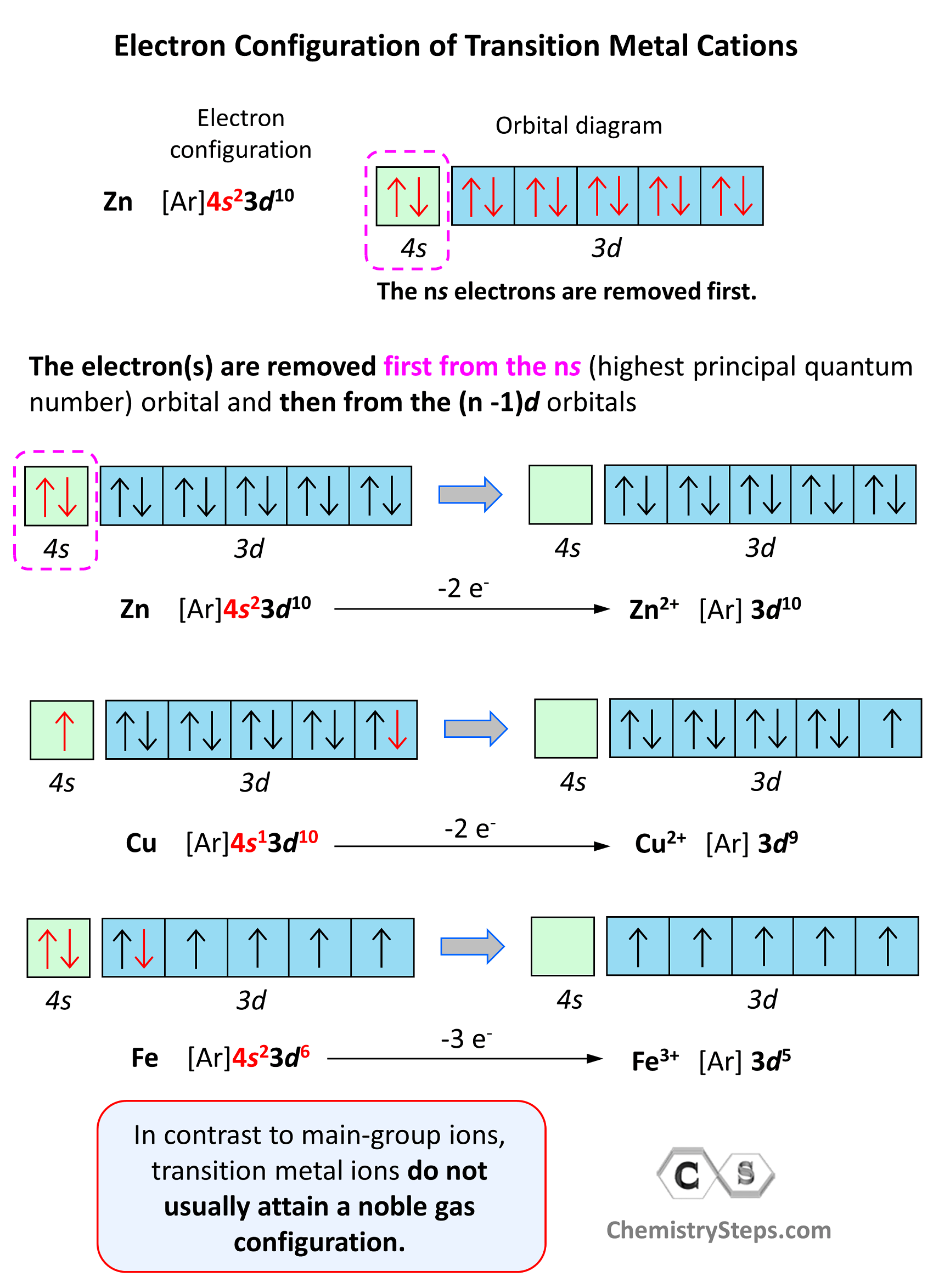
For example, iron commonly forms Fe2+ and Fe3+. Neutral iron has the configuration [Ar] 4s2 3d6. When Fe2+ forms, the two 4s electrons are removed, leaving [Ar] 3d6. When Fe3+ forms, one additional electron is removed from the 3d subshell, giving [Ar] 3d5.
The ability of transition elements to access different oxidation states is one reason their chemistry is more varied than the chemistry of many main-group elements.
Source: general.chemistrysteps.com
Iron
Fe commonly forms Fe2+ and Fe3+, corresponding to different numbers of d electrons after the 4s electrons are removed.
Copper
Cu commonly forms Cu+ and Cu2+, illustrating that different oxidation states can involve different electron configurations.
Manganese
Mn can form several oxidation states, reflecting the availability of its 4s and 3d electrons.
Why Are 4s Electrons Removed Before 3d Electrons?
A frequent source of confusion is the order in which electrons are removed. Although the 4s orbital is filled before the 3d orbital in the usual construction of neutral transition-metal electron configurations, once the d subshell is occupied, the relative energies change. For transition-metal cations, the ns electrons are generally removed before the (n−1)d electrons.
For example, neutral iron is commonly written as [Ar] 4s2 3d6, but Fe2+ is [Ar] 3d6 rather than [Ar] 4s2 3d4.
Important Exceptions: Chromium and Copper
Chromium and copper are the two most commonly emphasized exceptions in the first transition series. A simple Aufbau prediction would suggest [Ar] 4s2 3d4 for chromium and [Ar] 4s2 3d9 for copper. Their observed ground-state configurations are different.
Chromium has [Ar] 4s1 3d5, while copper has [Ar] 4s1 3d10. These arrangements are associated with particularly stable d-subshell occupations. The small energy differences between the 4s and 3d orbitals allow the actual ground-state configuration to differ from the simplest filling prediction.
These exceptions matter when calculating valence electrons because the actual electron configuration, rather than a simplified predicted configuration, should be used.
Source: pediabay.com
Chromium
Actual configuration: [Ar] 4s1 3d5. The d subshell is half-filled.
Copper
Actual configuration: [Ar] 4s1 3d10. The d subshell is completely filled.
Study tip
Memorize chromium and copper as important exceptions when learning first-row transition-metal configurations.
Does the Group Number Give the Number of Valence Electrons?
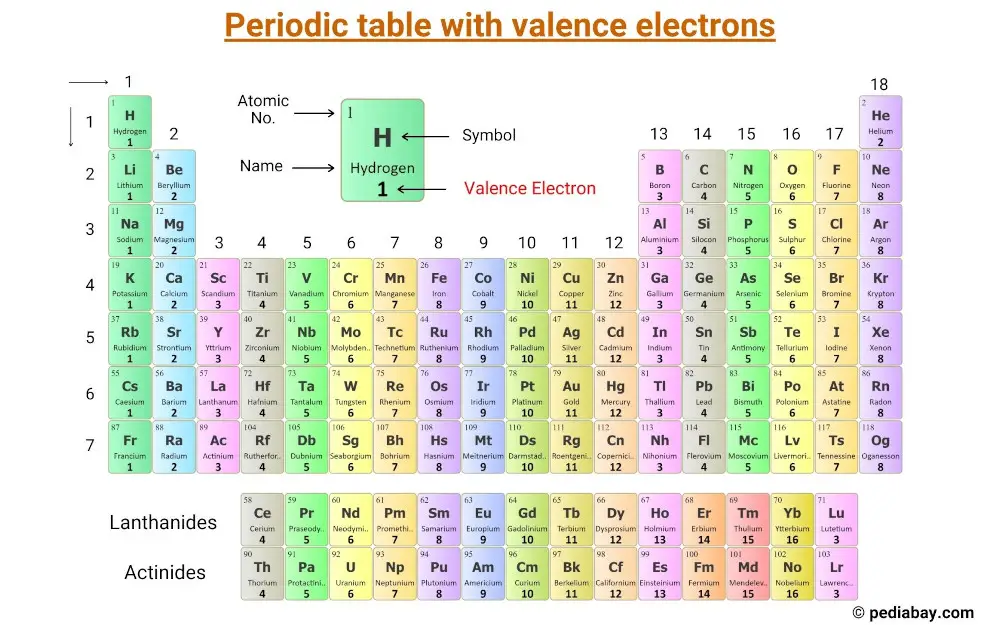
Not reliably for transition elements. Group numbers are useful for locating elements and recognizing broad periodic trends, but transition-metal valence electrons cannot always be determined by applying the simple main-group rule.
For example, iron is in group 8, and its broader valence-electron count is eight. But other transition elements demonstrate why group number alone is not a complete method. Electron configuration provides the more reliable basis for determining which s and d electrons are available.
Valence Electrons in Transition-Metal Ions
The valence-electron count changes when a transition element becomes an ion. The first step is to remove electrons from the outer ns orbital, followed by removal from the d orbital when additional electrons must be removed.
For example, titanium has the neutral configuration [Ar] 4s2 3d2. Titanium(II), Ti2+, loses both 4s electrons and becomes [Ar] 3d2. Titanium(III) becomes [Ar] 3d1, while titanium(IV) becomes [Ar].
This behavior explains why the electron configuration of a transition-metal ion should be written directly rather than obtained by simply subtracting electrons from the end of the neutral configuration.
Ti
Neutral Ti: [Ar] 4s2 3d2.
Ti2+
Ti2+: [Ar] 3d2 after removal of the two 4s electrons.
Fe
Neutral Fe: [Ar] 4s2 3d6.
Fe2+
Fe2+: [Ar] 3d6 after removal of the two 4s electrons.
Fe3+
Fe3+: [Ar] 3d5 after removal of two 4s electrons and one 3d electron.
A Common Exam Mistake
Do not remove the 3d electrons before the 4s electrons when forming common transition-metal cations. The usual procedure is to remove electrons from the highest principal quantum number first. Thus, 4s electrons are removed before 3d electrons for first-row transition metals.
Frequently Asked Questions
Q
How many valence electrons do transition elements have?
There is no single number that applies to all transition elements. Their valence electrons can include both ns and (n−1)d electrons. In the first transition series, the broader count ranges from three for scandium to twelve for zinc when both subshells are counted, with chromium and copper having exceptional configurations.
Q
Why are transition elements said to have variable valence electrons?
The ns and (n−1)d orbitals are relatively close in energy, so electrons from both subshells can participate in bonding and ion formation. This allows transition elements to form ions with different oxidation states.
Q
How many valence electrons does iron have?
Neutral iron has the electron configuration [Ar] 4s2 3d6. Under the broader transition-metal definition, the 4s and 3d electrons are considered valence electrons, giving iron eight valence electrons. For Fe2+, the configuration is [Ar] 3d6.
Q
Do transition metals lose 4s or 3d electrons first?
For common transition-metal cations, the ns electrons are removed before the (n−1)d electrons. For example, iron loses its two 4s electrons to form Fe2+, leaving [Ar] 3d6.
Q
Why are chromium and copper exceptions?
Chromium has [Ar] 4s1 3d5 instead of the simple predicted [Ar] 4s2 3d4 configuration, and copper has [Ar] 4s1 3d10 instead of [Ar] 4s2 3d9. The close energy relationship between the 4s and 3d orbitals permits these more stable arrangements.
Q
Is zinc a transition element?
Zinc belongs to the d-block, but under the strict definition it is not a transition element because its atom and common Zn2+ ion have a completely filled 3d subshell. Many introductory chemistry resources nevertheless discuss zinc alongside the transition metals because it occupies group 12.
✦ Wrapping Up
Conclusion
The valence electrons of transition elements are best understood through their electron configurations. Unlike main-group elements, transition elements can have chemically relevant electrons in both the outer ns subshell and the nearby (n−1)d subshell.
The first-row transition elements illustrate this pattern clearly. Scandium through zinc gradually fill the 3d subshell, while chromium and copper show important electron-configuration exceptions. The ability of both s and d electrons to participate in chemical processes helps explain the variable oxidation states that are characteristic of transition-metal chemistry.
When solving chemistry problems, write the electron configuration first, identify the ns and (n−1)d electrons, and remember that transition-metal cations generally lose ns electrons before d electrons. This method is more dependable than applying the simple main-group valence-electron rule to the d-block.
💡 Key Takeaway
To find the valence electrons of a transition element, write its ground-state electron configuration, identify the ns and (n−1)d subshells, count the relevant electrons, and check for known configuration exceptions such as chromium and copper.




No comments