Most main-group metals have one to three valence electrons, while transition metals have more complex valence-electron configurations involving s and d electrons.
For students studying chemistry in the United States, understanding the valence electrons of metals is a key step toward understanding ionic bonding, oxidation states, electron configurations, and the behavior of elements on the periodic table. Valence electrons are the electrons that participate most directly in chemical interactions, but the way they are counted differs between main-group metals and transition metals.
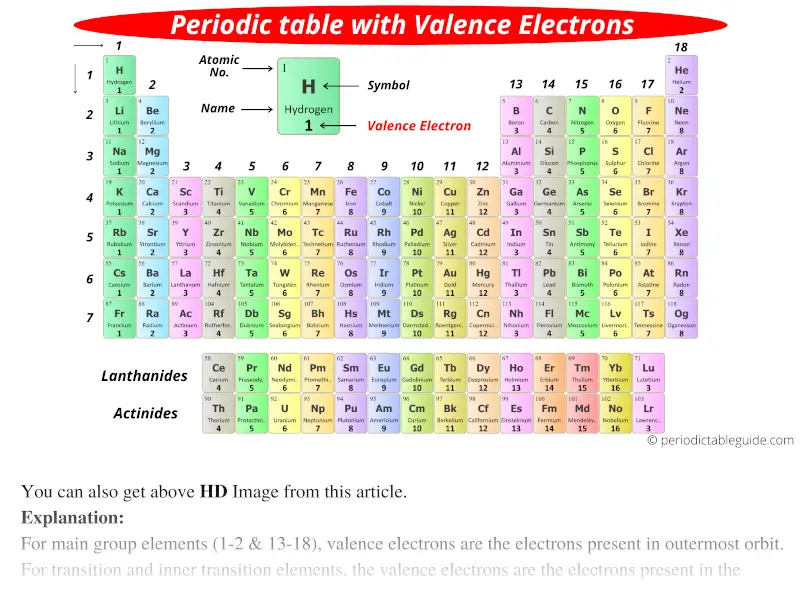
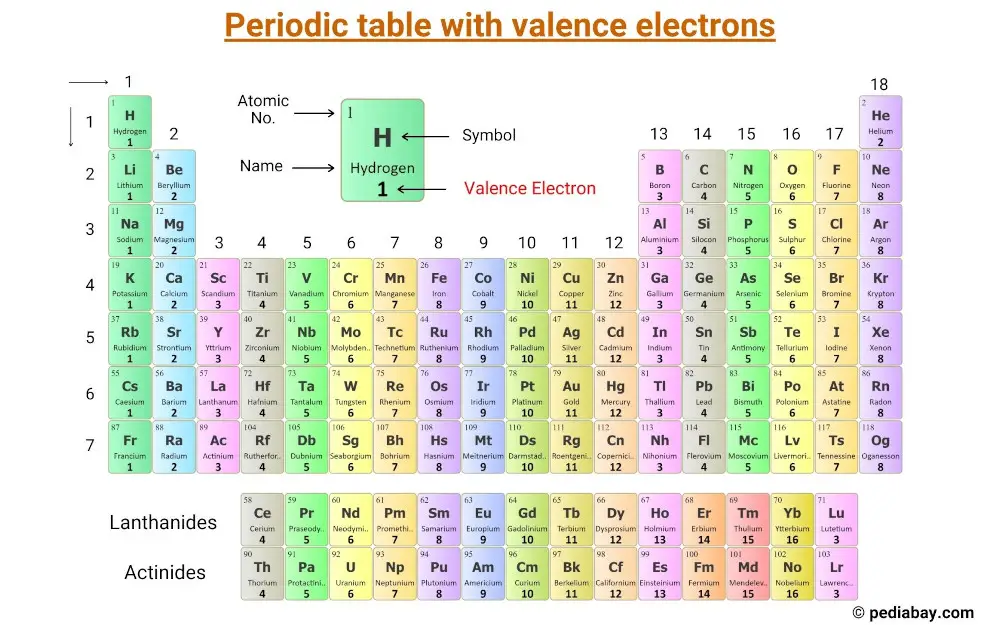
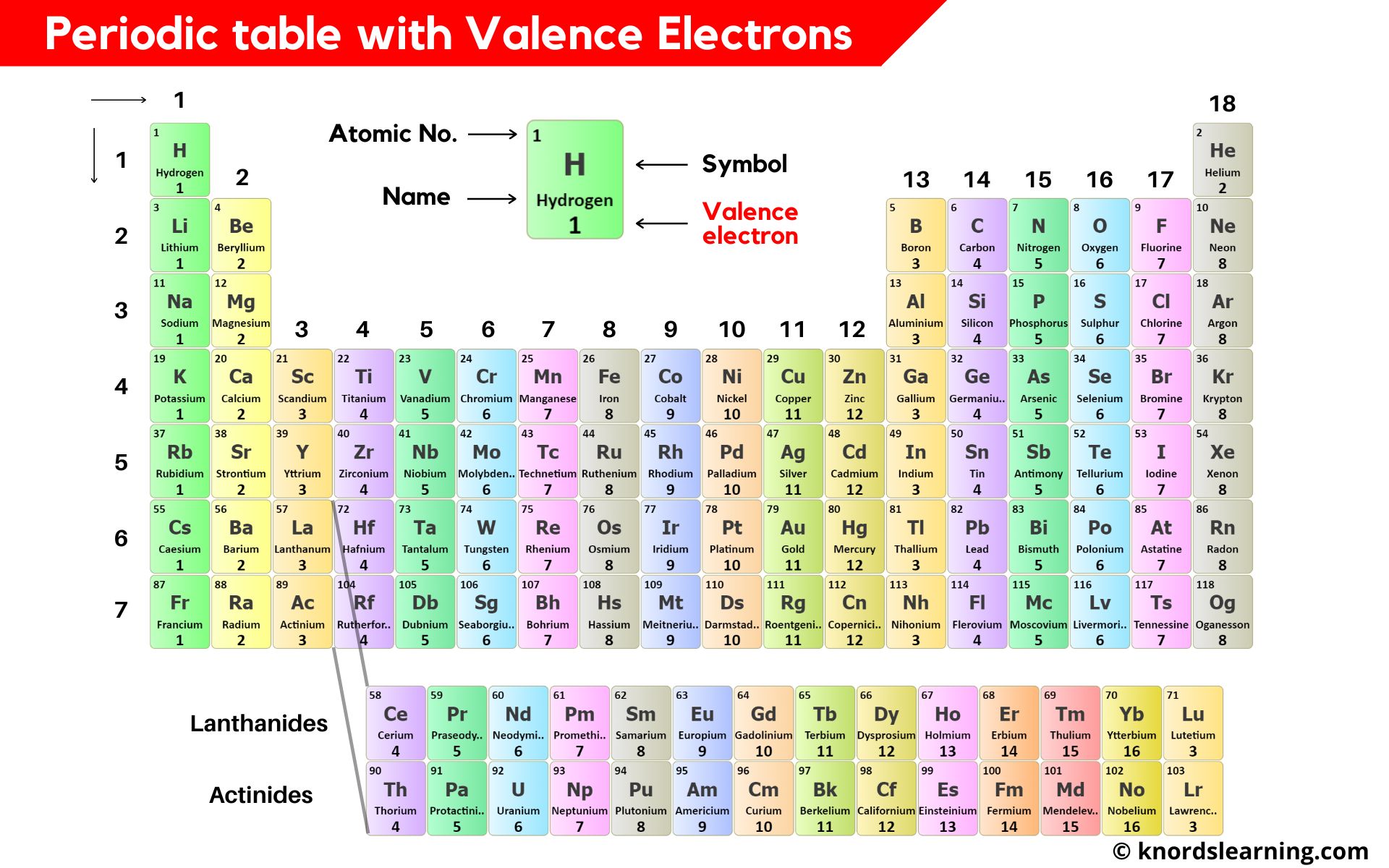
For main-group metals, the number of valence electrons can often be predicted from the periodic table group. Metals in Group 1 generally have one valence electron, Group 2 metals have two, and many metals in Groups 13 and 14 have three or four valence electrons. Transition metals require closer attention because their partially filled d orbitals can participate in bonding and help produce multiple oxidation states.
Source: wikihow.com
What Are Valence Electrons in Metals?
Valence electrons are electrons associated with the outer or chemically accessible part of an atom. These electrons are especially important because they can participate in chemical bonding and are generally less tightly held than inner core electrons.
For a main-group metal, the valence electrons are normally the electrons in the highest principal energy level. For transition metals, the situation is more complicated because electrons in the outer ns orbital and the nearby (n−1)d subshell can both contribute to chemical behavior.
This distinction matters when explaining why metals form cations, why transition metals can have several oxidation states, and why the simple group-number rule works well for some metals but not for others.
Source: jadynfersespinoza.blogspot.com
Main-group metals
Their valence-electron count is usually easy to determine from the outermost s and p orbitals.
Transition metals
Their chemically relevant electrons can include both ns and (n−1)d electrons.
Metal ions
When metals form positive ions, they lose electrons, usually beginning with the outermost electrons.
Valence Electrons vs. Core Electrons
Core electrons are inner electrons that generally do not participate directly in ordinary chemical bonding. Valence electrons are more chemically accessible and play a much larger role in determining how an element reacts.
For example, sodium has the electron configuration 1s² 2s² 2p⁶ 3s¹. The 3s¹ electron is the outermost electron and is the valence electron. The other ten electrons are core electrons.
Sodium
Sodium has one valence electron and commonly forms Na⁺ by losing that electron.
Magnesium
Magnesium has two outer-shell electrons and commonly forms Mg²⁺ by losing both.
How Many Valence Electrons Do Metals Have?
There is no single number of valence electrons shared by all metals. The number depends on the metal's position in the periodic table and its electron configuration.
For many main-group metals, the periodic table provides a quick answer. Group 1 metals generally have one valence electron, Group 2 metals generally have two, and metals in Group 13 generally have three. Some metals farther to the right in the p block have four or more valence electrons, although their chemical behavior can be more complex.
Source: animalia-life.club
Group 1 metals
Lithium, sodium, potassium, and other Group 1 metals generally have one valence electron.
Group 2 metals
Beryllium, magnesium, calcium, and other Group 2 metals generally have two valence electrons.
Group 13 metals
Aluminum and several heavier Group 13 metals have an outer-shell configuration of ns²np¹, giving three outer-shell valence electrons.
Examples of Valence Electrons in Common Metals
Sodium has the electron configuration [Ne]3s¹, so it has one outer-shell valence electron. Magnesium has [Ne]3s², giving it two outer-shell valence electrons. Aluminum has [Ne]3s²3p¹, giving it three outer-shell valence electrons.
These examples show the basic relationship between periodic-table position and valence-electron configuration for main-group metals.
Sodium, Na
Electron configuration [Ne]3s¹; one outer-shell valence electron.
Magnesium, Mg
Electron configuration [Ne]3s²; two outer-shell valence electrons.
Aluminum, Al
Electron configuration [Ne]3s²3p¹; three outer-shell valence electrons.
Valence Electrons of Transition Metals
Transition metals cannot always be assigned a simple valence-electron count using the main-group rule. Their electron configurations involve both an outer ns subshell and a nearby (n−1)d subshell, and both can influence chemical behavior.
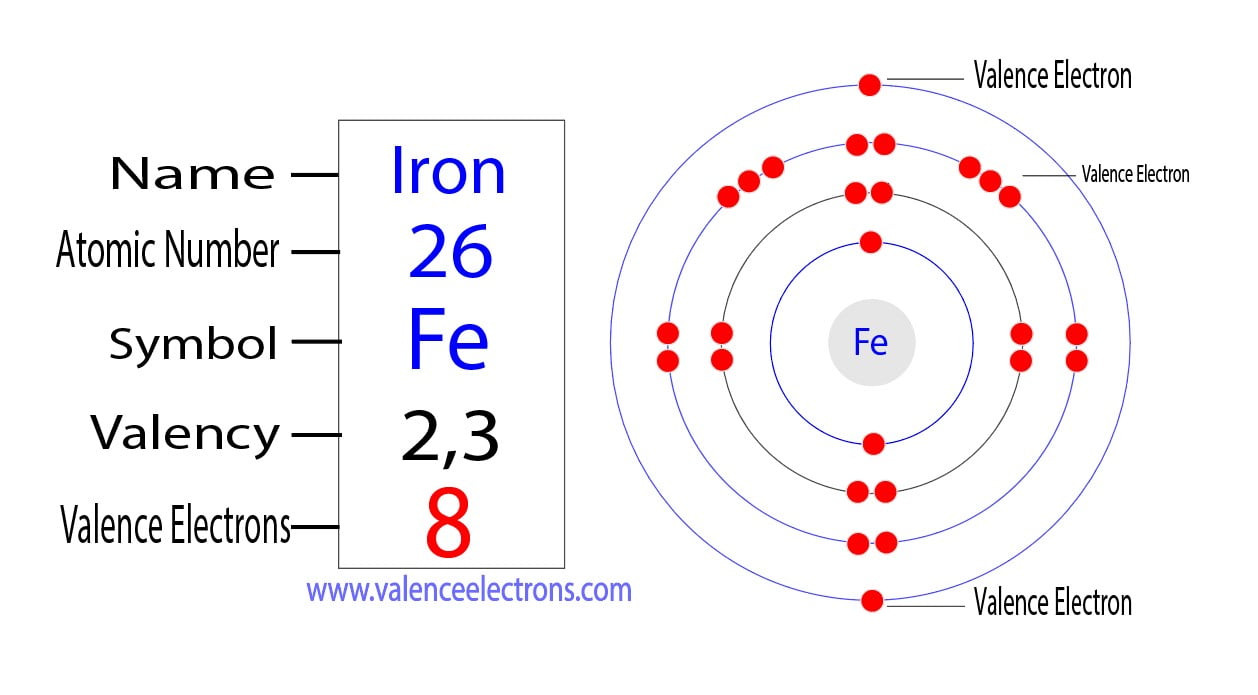
For example, iron has the ground-state electron configuration [Ar]3d⁶4s². The two 4s electrons are in the highest principal energy level, while the 3d electrons are in the next lower principal level. In transition-metal chemistry, the d electrons can also participate in bonding and oxidation-state changes.
This is why iron can form both Fe²⁺ and Fe³⁺ ions. Iron commonly loses its 4s electrons first, and Fe³⁺ formation also involves the loss of one 3d electron.
Source: valenceelectrons.com
Iron
Iron has the ground-state configuration [Ar]3d⁶4s² and commonly forms Fe²⁺ and Fe³⁺ ions.
Titanium
Titanium has the ground-state configuration [Ar]3d²4s², with both s and d electrons relevant to its chemistry.
Copper
Copper has the ground-state configuration [Ar]3d¹⁰4s¹, an example of an electron configuration that does not follow a simple expected filling pattern.
Why Transition Metals Have Multiple Oxidation States
The energies of the ns and (n−1)d electrons in transition metals are relatively close compared with the much larger energy separation between core and valence electrons. As a result, different numbers of these electrons can participate in ion formation and bonding.
This helps explain why transition metals frequently show multiple oxidation states. Iron, for example, commonly occurs as Fe²⁺ and Fe³⁺, while copper commonly occurs as Cu⁺ and Cu²⁺.
Electron loss
When transition metals ionize, the outer ns electrons are generally removed before the d electrons.
Chemical flexibility
The involvement of d electrons allows transition metals to display several oxidation states.
How to Find the Valence Electrons of a Metal
The easiest method depends on whether the metal is a main-group element or a transition metal. For main-group metals, the periodic table group often provides the answer. For transition metals, write or inspect the electron configuration.
Use the following process when solving a chemistry problem. First identify the element and determine whether it belongs to the main group, d block, or f block. Then examine its electron configuration and identify the electrons that can participate in chemical behavior.
Source: theory.labster.com
Step 1: Identify the metal
Locate the element on the periodic table and determine its group and block.
Step 2: Check whether it is a main-group metal
For main-group metals, examine the highest principal energy level and count the s and p electrons there.
Step 3: Check whether it is a transition metal
For transition metals, consider both the outer ns electrons and the relevant (n−1)d electrons.
Step 4: Use the electron configuration
If the group rule creates uncertainty, the electron configuration gives the more detailed explanation.
Worked Example: Finding the Valence Electrons of Magnesium
Magnesium has atomic number 12. Its electron configuration is 1s²2s²2p⁶3s², or [Ne]3s². The highest principal energy level is n = 3, and that level contains two electrons in the 3s orbital. Therefore, magnesium has two outer-shell valence electrons.
Magnesium commonly loses these two electrons to form Mg²⁺. The resulting ion has the electron configuration of neon, a noble gas.
Configuration
Mg = [Ne]3s².
Valence electrons
Two electrons occupy the highest principal energy level.
Common ion
Mg commonly forms Mg²⁺ after losing its two outer-shell electrons.
Valence Electrons and the Formation of Metal Ions
Metals commonly form positive ions, called cations, because their atoms can lose electrons. Losing negatively charged electrons leaves the atom with more protons than electrons and therefore a positive charge.
For many main-group metals, the number of electrons lost corresponds closely to the number of outer-shell electrons. Sodium loses one electron to form Na⁺, magnesium loses two to form Mg²⁺, and aluminum commonly loses three to form Al³⁺.
Transition metals do not follow such a simple pattern. They can lose different numbers of electrons because both ns and d electrons can be involved. Iron is a familiar example because both Fe²⁺ and Fe³⁺ are common.
Source: ar.inspiredpencil.com
Sodium
Na loses one electron and forms Na⁺.
Magnesium
Mg loses two electrons and forms Mg²⁺.
Aluminum
Al commonly loses three electrons and forms Al³⁺.
Iron
Fe commonly forms Fe²⁺ and Fe³⁺ because its d and s electrons can contribute to ion formation.
Valence Electrons and Metallic Bonding
Valence electrons also help explain metallic bonding. In a simplified model of a metal, valence electrons are not confined to individual atoms in the same way as many localized covalent-bonding electrons. They can move through the metal lattice, contributing to electrical and thermal conductivity.
This model helps connect atomic electron structure with familiar metallic properties such as electrical conductivity, thermal conductivity, and the ability of many metals to deform without breaking apart like a typical ionic crystal.
Electrical conductivity
Mobile electrons in metals allow electric charge to move through the material.
Thermal conductivity
Mobile electrons contribute to the transfer of thermal energy through many metals.
Common Mistakes When Counting Valence Electrons of Metals
The most common mistake is treating every metal as if it followed the same simple group-number rule. That approach works well for many main-group metals but becomes unreliable for transition metals.
Another common error is assuming that every electron in a transition metal's electron configuration should automatically be counted as a valence electron. The definition used can depend on whether the discussion focuses strictly on the outermost shell or on electrons that participate in chemical behavior.
Source: knordslearning.com
Mistake 1: Applying the main-group rule to transition metals
Transition metals require consideration of their d electrons, so a simple group-number shortcut can give an incomplete answer.
Mistake 2: Confusing valence electrons with valency
Valence electrons are electrons involved in an atom's outer or chemically relevant electron structure, while valency describes combining capacity and is not simply another name for the electron count.
Mistake 3: Assuming oxidation state equals valence-electron count
Oxidation state describes electron accounting in a compound. It is not always equal to the number of valence electrons in the neutral atom.
Mistake 4: Ignoring unusual electron configurations
Some elements, including chromium and copper, have ground-state configurations that differ from the simplest expected filling pattern.
A Useful Rule of Thumb
For introductory chemistry, use the periodic-table group to count valence electrons for main-group metals, then switch to electron configuration when dealing with transition or inner-transition metals.
This approach keeps the shortcut where it is reliable while avoiding the common mistake of forcing transition-metal chemistry into a main-group model.
Main-group metal
Start with the group number and outer-shell electron configuration.
Transition metal
Use the electron configuration and consider the ns and (n−1)d electrons.
Frequently Asked Questions
Q
How many valence electrons do metals usually have?
Many main-group metals have one, two, or three valence electrons. Group 1 metals generally have one, Group 2 metals generally have two, and Group 13 metals generally have three outer-shell electrons. Transition metals are more complicated because d electrons can also participate in chemical behavior.
Q
Which metal has one valence electron?
Group 1 metals generally have one valence electron. Examples include lithium, sodium, potassium, rubidium, and cesium. These metals commonly lose that electron to form +1 ions.
Q
How many valence electrons does iron have?
Neutral iron has the ground-state electron configuration [Ar]3d⁶4s². If valence electrons are defined strictly as electrons in the highest principal energy level, the two 4s electrons are the outer-shell electrons. In transition-metal chemistry, however, the 3d electrons are also chemically relevant and can participate in bonding and oxidation-state changes.
Q
Do transition metals have two valence electrons?
Not necessarily. Many transition metals have an outer ns² configuration, but their d electrons can also participate in chemical behavior. Therefore, describing every transition metal as having exactly two chemically relevant valence electrons is an oversimplification.
Q
Why do metals lose valence electrons?
Metals generally have relatively accessible outer electrons. Losing these electrons produces positively charged ions and can result in a more stable electron configuration. The exact number of electrons lost depends on the element and its chemical environment.
✦ Wrapping Up
Conclusion
The valence electrons of metals are central to understanding how metallic elements form ions, participate in chemical bonding, and behave across the periodic table. Main-group metals often follow a straightforward pattern based on their group, while transition metals require electron configurations because their d electrons can also influence chemical behavior.
For basic chemistry problems, first identify whether the metal is a main-group or transition element. For main-group metals, the periodic table often provides a quick answer. For transition metals, examine the electron configuration and distinguish between the outermost shell and the broader set of electrons that can participate in chemical reactions.
💡 Key Takeaway
When asked to find the valence electrons of a metal, identify its periodic-table block first. Use the group number for a reliable shortcut with many main-group metals, but use the electron configuration for transition metals and other cases where the simple rule does not fully describe the chemistry.





No comments