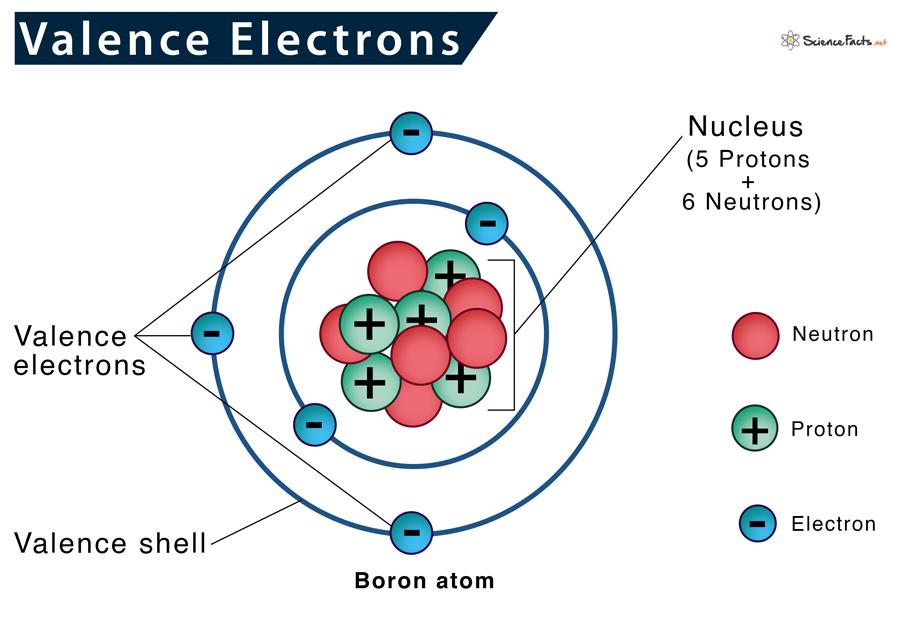
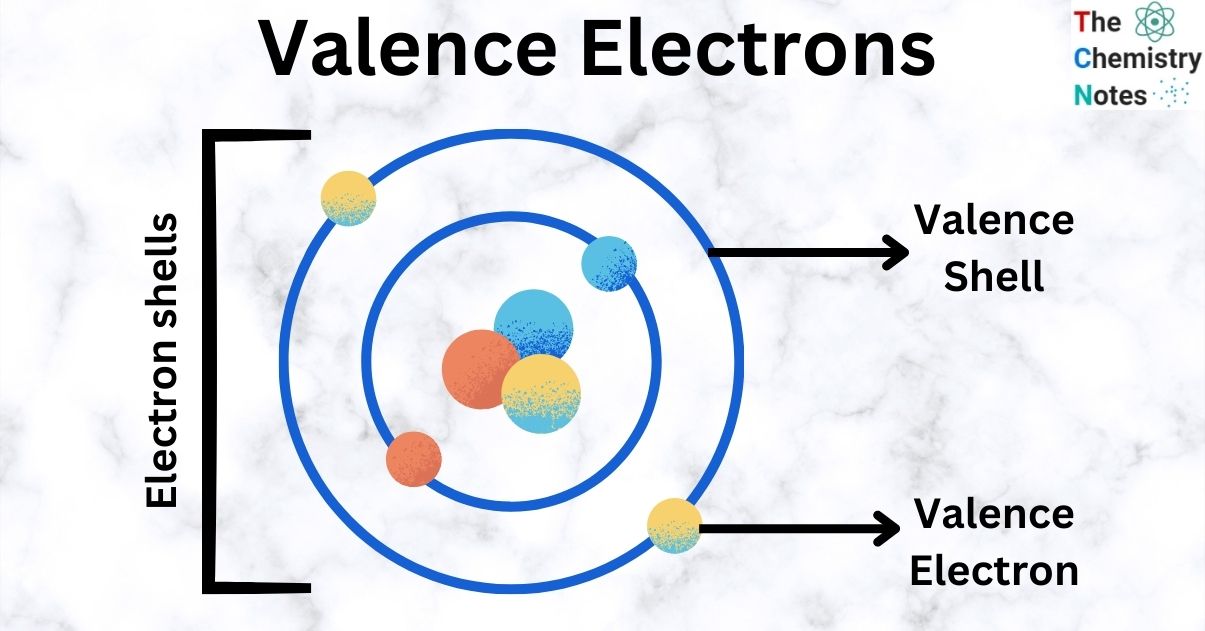
Valence electrons are located in the outermost occupied energy level, or valence shell, of an atom.
For students studying chemistry in U.S. classrooms, the location of valence electrons is one of the most useful ideas for understanding how atoms interact. Valence electrons occupy the outermost occupied electron shell of an atom and are the electrons most directly involved in chemical bonding and many chemical reactions.
The exact location can be identified from an atom's electron configuration or, for many main-group elements, from its position on the periodic table. Knowing where these electrons are located helps explain why elements in the same group often have similar chemical properties and why atoms gain, lose, or share electrons during bonding.
Source: sciencefacts.net
What Is the Location of Valence Electrons?
The location of valence electrons is the outermost occupied energy level of an atom. This region is commonly called the valence shell. Electrons in this shell are farther from the nucleus than electrons in the inner shells and generally participate more directly in chemical interactions.
An atom can have several occupied electron shells. The shell closest to the nucleus has the lowest principal energy level, while shells farther from the nucleus generally have higher principal energy levels. The valence shell is the highest principal energy level that contains electrons in the atom's ground-state electron configuration.
For example, sodium has the electron configuration 1s² 2s² 2p⁶ 3s¹. The highest occupied principal energy level is n = 3, so the electron in the 3s orbital is a valence electron. The electrons in the first and second shells are inner electrons.
Source: scienceinfo.com
Valence shell
The outermost occupied principal energy level of an atom.
Valence electrons
Electrons associated with the valence shell that are most involved in chemical bonding and reactivity.
Inner electrons
Electrons in lower occupied energy levels that are generally less directly involved in ordinary chemical bonding.
Why Are Valence Electrons Located on the Outside?
Electrons occupy atomic orbitals according to their energy. As additional energy levels are occupied, electrons can be found farther from the nucleus on average. The outermost occupied level is therefore the part of the electron structure that interacts most directly with neighboring atoms.
Because these electrons are relatively far from the positively charged nucleus and are shielded by inner electrons, they can be more easily affected during chemical interactions than inner-shell electrons.
What Is the Valence Shell?
The valence shell is the outermost occupied electron shell in an atom's ground-state electron configuration. It is identified by the highest principal quantum number, represented by n, that contains electrons.
For example, magnesium has the electron configuration 1s² 2s² 2p⁶ 3s². The highest occupied energy level is n = 3. Therefore, the third shell is magnesium's valence shell, and its two 3s electrons are its valence electrons.
The terms valence shell and valence electrons are related but are not interchangeable. The valence shell describes an energy level, while valence electrons describe the electrons associated with that outer region.
Source: howtomechatronics.com
First shell
The n = 1 shell can contain the 1s orbital and holds a maximum of two electrons.
Second shell
The n = 2 shell contains 2s and 2p orbitals and can hold up to eight electrons.
Third shell
The n = 3 shell can contain 3s, 3p, and 3d orbitals, although the filling order of orbitals does not simply follow shell number.
Example: Finding the Valence Shell of Chlorine
Chlorine has 17 electrons. Its electron configuration is 1s² 2s² 2p⁶ 3s² 3p⁵. The highest occupied principal energy level is n = 3, so the third shell is the valence shell. Chlorine has seven valence electrons: two in 3s and five in 3p.
Highest occupied level
n = 3
Valence-shell configuration
3s² 3p⁵
Number of valence electrons
7
How Do You Find the Location of Valence Electrons?
The most reliable way to locate valence electrons is to examine the electron configuration. Find the highest principal energy level, then identify the electrons occupying that outermost occupied level.
For main-group elements, the periodic table provides a faster method. Elements in the same group generally have the same number of electrons in their outermost s and p orbitals, which explains many similarities in their chemical behavior.
Source: savemyexams.com
Step 1: Write the electron configuration
Determine the arrangement of the atom's electrons in its orbitals.
Step 2: Find the highest principal energy level
Look for the largest value of n that contains electrons.
Step 3: Identify electrons in that outer level
These electrons are the valence electrons for the standard main-group treatment.
Step 4: Check the periodic table
For main-group elements, the group position can provide a quick check of the valence-electron count.
Example: Oxygen
Oxygen has eight electrons and the electron configuration 1s² 2s² 2p⁴. The highest occupied energy level is n = 2. The electrons in 2s² and 2p⁴ are therefore the valence electrons, giving oxygen six valence electrons.
Example: Calcium
Calcium has 20 electrons and the electron configuration [Ar] 4s². The highest occupied energy level is n = 4. The two electrons in the 4s orbital are calcium's valence electrons.
Where Are Valence Electrons on the Periodic Table?
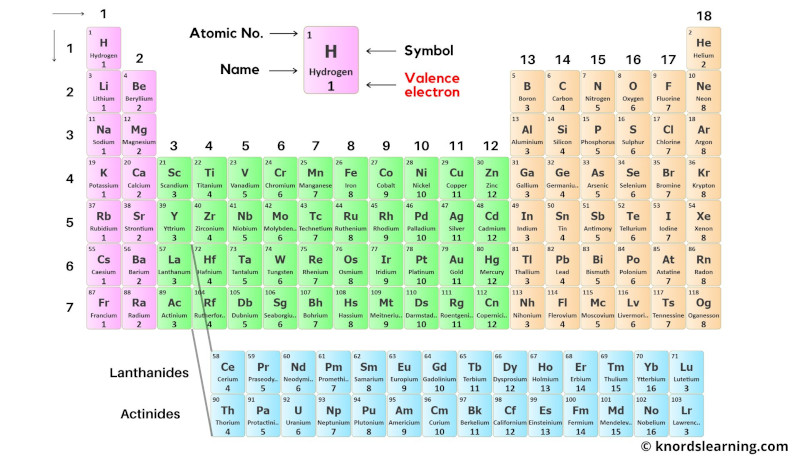
For main-group elements, the number of valence electrons follows a useful pattern across the periodic table. Groups 1 and 2 generally have one and two valence electrons, respectively. Groups 13 through 18 generally have three through eight valence electrons, with helium as an important exception because it has only two electrons in its first and only occupied shell.
This pattern allows students to estimate the number of valence electrons without writing the complete electron configuration. The group number is especially useful for the representative elements in Groups 1, 2, and 13 through 18.
Source: printableshub.com
Group 1
Main-group elements generally have 1 valence electron.
Group 2
Main-group elements generally have 2 valence electrons.
Groups 13 through 18
These groups generally have 3 through 8 valence electrons, respectively.
Helium
Helium has 2 valence electrons even though it is placed in Group 18 because its first shell is complete with two electrons.
Valence Electrons and Periodic Trends
Elements in the same main-group column often have similar chemical properties because they have similar outer-electron configurations. Moving across a period generally changes the number of valence electrons for main-group elements, while moving down a group adds another occupied energy level but preserves the general outer-electron pattern.
Why Does the Location of Valence Electrons Matter?
The location of valence electrons matters because these electrons strongly influence how an atom interacts with other atoms. Chemical bonds form through changes in the arrangement of electrons, and valence electrons are usually the electrons involved in those changes.
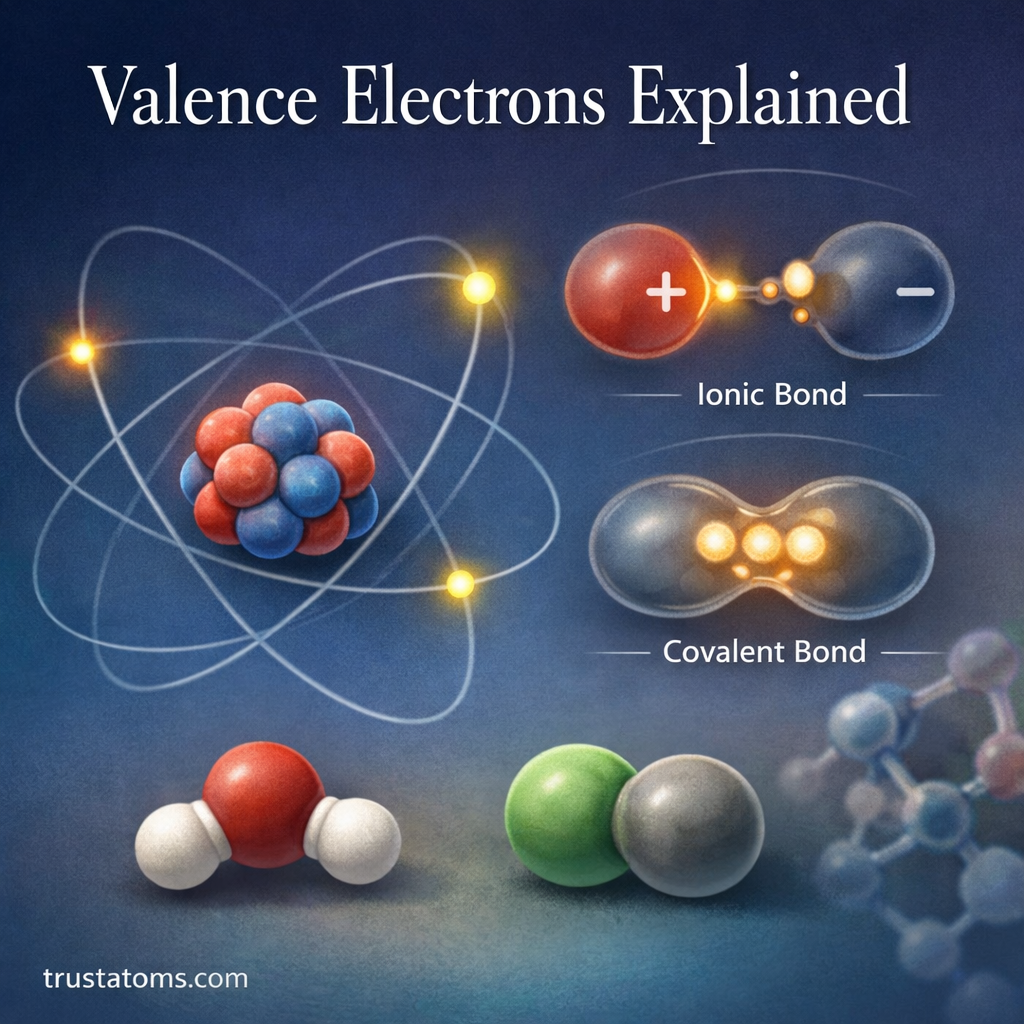
Atoms often become more stable by gaining, losing, or sharing electrons. For example, sodium has one valence electron and can lose it to form a positively charged sodium ion. Chlorine has seven valence electrons and can gain one electron to form a negatively charged chloride ion. Sodium and chlorine can then form an ionic compound, sodium chloride.
Valence electrons also explain covalent bonding. In a molecule such as water, oxygen shares electrons with hydrogen atoms. The shared electrons contribute to the outer electron arrangements of the bonded atoms.
Source: knordslearning.com
Ionic bonding
Valence electrons may be transferred from one atom to another, producing oppositely charged ions.
Covalent bonding
Atoms share valence electrons to form covalent bonds.
Metallic bonding
In metals, valence electrons can participate in a delocalized electron system that contributes to metallic properties.
Valence Electrons and Chemical Reactivity
Chemical reactivity is strongly influenced by the number and arrangement of valence electrons. Main-group atoms with nearly empty or nearly full outer shells often react in ways that help them reach a more stable electron arrangement.
This is why elements such as the alkali metals are highly reactive compared with noble gases under ordinary conditions. Alkali metals have one outer electron, while noble gases generally have filled valence shells. Reactivity, however, depends on more than valence-electron count alone and can vary substantially across the periodic table.
Common Mistakes About the Location of Valence Electrons
Students often confuse the outermost shell with the shell that contains the last electron added according to a simplified filling sequence. These ideas are related but are not always identical, especially when transition elements are considered.
Another common mistake is assuming that every element has the same simple valence-electron pattern as a main-group element. The transition metals require more careful treatment because their chemistry can involve electrons from both the outer ns orbital and the nearby (n−1)d orbitals.
Source: trustatoms.com
Mistake: Valence electrons are always the farthest electrons from the nucleus
The phrase is a useful introductory description, but valence behavior is determined by electron configuration and orbital energy, not simply physical distance.
Mistake: The group number always equals the valence-electron count
This shortcut works well for many main-group elements but should not be applied without qualification to transition metals.
Mistake: Inner electrons never affect chemistry
Inner electrons usually do not participate directly in ordinary bonding, but electron shielding and effective nuclear charge influence atomic size, ionization energy, and chemical behavior.
Mistake: Valence shell and valence electrons mean the same thing
The valence shell is an energy level, while valence electrons are the electrons occupying relevant outer orbitals.
What About Transition Metals?
Transition metals are a major qualification to the simple main-group rule. Their electron configurations involve the ns and (n−1)d subshells, and both can contribute to bonding and oxidation-state behavior. For this reason, counting valence electrons in transition metals depends on the chemical context and the definition being used.
For introductory chemistry, it is usually safest to learn the main-group pattern first and then treat transition-metal valence electrons using the specific convention required by the course or textbook.
Frequently Asked Questions
Q
Where exactly are valence electrons located?
Valence electrons are located in the outermost occupied energy level of an atom. This level is called the valence shell. In a basic main-group model, these are the electrons most directly involved in chemical bonding.
Q
Are valence electrons always in the outermost shell?
For the standard introductory definition, valence electrons are associated with the outermost occupied shell. However, transition metals are more complicated because d electrons from an inner principal energy level can participate in chemical bonding and oxidation-state changes.
Q
How can I find valence electrons from an electron configuration?
Find the highest principal energy level, represented by the largest n value. For a main-group atom, the electrons in that outer level are its valence electrons. For example, sulfur has the configuration 1s² 2s² 2p⁶ 3s² 3p⁴, so it has six valence electrons in the n = 3 shell.
Q
How do I find valence electrons from the periodic table?
For main-group elements, use the group position. Group 1 generally has one valence electron, Group 2 has two, and Groups 13 through 18 generally have three through eight. Helium is the exception to the simple Group 18 count because it has two electrons in its first shell.
Q
Why are valence electrons important in chemistry?
Valence electrons are important because they participate strongly in chemical bonding and influence how atoms form ions and molecules. Their number and arrangement help explain many periodic trends and similarities among elements in the same group.
✦ Wrapping Up
Conclusion
The location of valence electrons is the outermost occupied energy level of an atom, known as the valence shell. These electrons are especially important because they are involved in many chemical interactions, including ionic, covalent, and metallic bonding.
For main-group elements, students can often identify valence electrons quickly from the periodic table. For a more precise answer, especially when studying transition metals, the electron configuration provides the necessary detail.
💡 Key Takeaway
To locate valence electrons, write the electron configuration, identify the highest occupied principal energy level, and examine the electrons associated with that outer level. Then use the periodic table as a quick check for main-group elements.




No comments