Electron Configuration of Nobelium
If you’ve ever wondered how the electrons arrange themselves in one of the rarest and heaviest elements on the periodic table, Nobelium is a fascinating case to explore. Understanding the electron configuration of Nobelium not only reveals the secrets of its chemical behavior but also helps you grasp the complex world of heavy elements.
You’ll discover how Nobelium’s electrons are distributed across its shells and orbitals, why this matters for its place in the periodic table, and what makes it unique among the actinides. Ready to unlock the mystery behind Nobelium’s electron configuration? Let’s dive in and make this complex topic clear and simple for you.
Basic Properties
Nobelium is a synthetic element with unique atomic characteristics. Its basic properties reveal important details about its structure. Understanding these helps grasp its electron arrangement and chemical behavior.
This section covers atomic number, mass, and particle composition. These facts form the foundation for studying nobelium's electron configuration.
Atomic Number And Mass
Nobelium’s atomic number is 102. This number defines the count of protons in its nucleus. The atomic mass is approximately 259 atomic mass units. This value represents the total mass of protons and neutrons combined.
Protons, Neutrons, And Electrons
Nobelium contains 102 protons and 102 electrons. The equal number of electrons and protons keeps the atom electrically neutral. Its neutron count varies in isotopes but usually is around 157 neutrons. These particles influence the element’s stability and isotopic form.
Electron Arrangement
The electron arrangement of Nobelium reveals how its electrons fill specific shells and subshells. This layout defines its chemical behavior and position in the periodic table. Understanding Nobelium’s electron arrangement helps explain its unique properties among actinides.
Electron Shells And Subshells
Electrons in Nobelium occupy energy levels called shells. Each shell contains subshells labeled s, p, d, and f. Nobelium’s electrons fill these subshells step-by-step, following strict rules. The outer shells hold electrons that influence chemical reactions.
5f And 7s Orbitals
Nobelium’s electrons mainly fill the 5f and 7s orbitals. The 5f orbital holds electrons deep inside the atom. The 7s orbital is the outermost and contains electrons that interact with other atoms. The balance between these orbitals shapes Nobelium’s chemical traits.
Electron Distribution By Energy Levels
Nobelium’s electrons arrange by increasing energy. Lower energy levels fill first before higher ones. This order follows the Aufbau principle. The final configuration shows electrons packed in shells 1 through 7, with 5f and 7s orbitals occupied. This distribution affects Nobelium’s stability and reactivity.
Orbital Diagrams
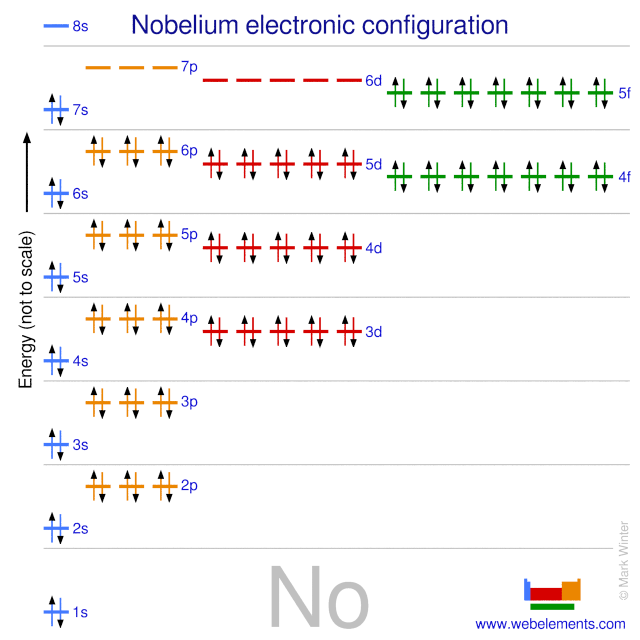
Orbital diagrams show how electrons occupy atomic orbitals. They help visualize electron arrangements in an atom. Each orbital can hold up to two electrons with opposite spins. Drawing these diagrams clarifies the electron distribution across different energy levels.
Understanding orbital diagrams is key to studying elements like Nobelium. This element has a complex electron configuration due to its position in the actinide series. Orbital diagrams make it easier to track electron placement in its various orbitals.
Möeller Diagram Application
The Möeller diagram guides the order in which orbitals fill with electrons. It uses arrows to show the filling sequence based on increasing energy. This tool helps avoid mistakes in writing electron configurations.
For Nobelium, the Möeller diagram confirms the filling of 5f and 7s orbitals. It ensures correct placement of electrons in these sublevels. This method simplifies understanding even complex elements.
Orbital Filling Order
Electrons fill orbitals starting with the lowest energy first. The order follows the Aufbau principle, Hund's rule, and the Pauli exclusion principle. Orbitals fill as 1s, 2s, 2p, 3s, and so on, reaching higher levels gradually.
Nobelium’s electrons fill up to the 5f and 7s orbitals. The filling sequence is crucial for predicting its chemical behavior. Following the correct order helps in drawing accurate orbital diagrams.
Orbital Diagram For Nobelium
Nobelium has 102 electrons arranged in its orbitals. Its diagram shows fully filled 5f orbitals and two electrons in the 7s orbital. The 5f orbitals hold 14 electrons, following the actinide pattern.
The diagram uses boxes for orbitals and arrows for electrons. Each box represents an orbital, and arrows indicate electron spins. This visual layout makes the electron configuration clear and easy to understand.
Periodic Table Position
Nobelium holds a unique position on the periodic table. Its place reveals much about its properties and behavior. Understanding its location helps explain its electron configuration and chemical traits.
Found in the heavy elements section, Nobelium is part of the actinide series. This position influences its atomic structure and reactivity.
Group And Period
Nobelium belongs to group 3 of the periodic table. It sits in period 7, the seventh row of elements. This period contains many heavy and radioactive elements. Nobelium's position here reflects its high atomic number, 102. Its electrons fill the 5f and 7s orbitals in this period.
Placement In The Actinide Series
Nobelium is the tenth element in the actinide series. The actinides run from actinium (element 89) to lawrencium (element 103). This series is known for filling the 5f electron shell. Nobelium’s electrons mainly occupy the 5f orbitals, with two electrons in the 7s orbital. This placement classifies it as an f-block element. Its position affects its magnetic and chemical properties.
Valence Electrons
Valence electrons play a crucial role in defining the chemical behavior of an element. For nobelium, these electrons are located in the outermost shell. They determine how nobelium interacts with other elements. Understanding valence electrons helps predict bonding patterns and reactivity.
Nobelium, with atomic number 102, belongs to the actinide series. Its valence electrons reside mainly in the 5f and 7s orbitals. These electrons influence its oxidation states and chemical properties. Studying the valence shell configuration provides insight into nobelium’s position in the periodic table.
Valence Shell Configuration
The valence shell of nobelium is characterized by the electrons in the 5f and 7s orbitals. Its electron configuration ends with 5f147s2. This means nobelium has a fully filled 5f subshell and two electrons in the 7s orbital. The filled 5f shell contributes to its stability and unique chemistry. The 7s electrons are more reactive and often involved in bonding.
This configuration places nobelium at the end of the actinide series. It exhibits a common +2 oxidation state due to the loss of the 7s electrons. Understanding this layout helps explain nobelium’s chemical behavior and its rarity in nature.
Lewis Structures
Lewis structures illustrate valence electrons as dots around the element’s symbol. For nobelium, the two 7s electrons are shown as dots. The 5f electrons are usually not depicted due to their complex involvement in bonding. This simplification helps focus on the most reactive electrons.
In a Lewis structure, nobelium is represented as "No" with two dots around it. These dots indicate the valence electrons available for bonding. This visual aids in predicting how nobelium forms compounds. It shows nobelium’s tendency to lose the two 7s electrons and form No2+ ions.
Credit: www.webelements.com
Abbreviated Configurations
Abbreviated electron configurations simplify the way we write the arrangement of electrons in an atom. They use noble gas symbols to replace the inner core electrons. This method saves space and makes the configuration easier to understand. For heavy elements like Nobelium, abbreviated configurations provide a clear and concise view of electron distribution.
Noble Gas Core Notation
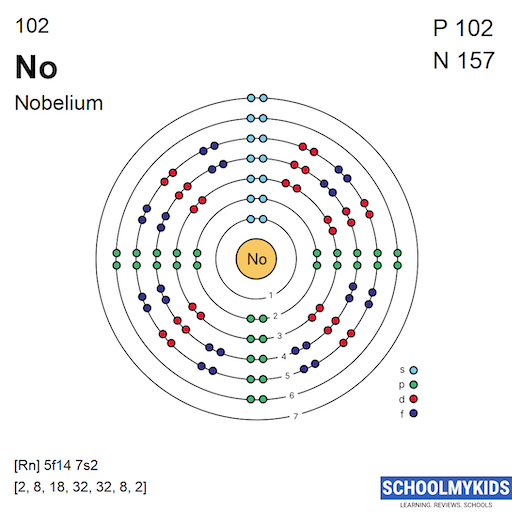
Noble gas core notation starts with the symbol of the nearest noble gas before the element. For Nobelium, the noble gas core is radon, represented as [Rn]. This means all electrons in radon’s configuration are included. After [Rn], the remaining electrons fill the 5f and 7s orbitals. The abbreviated configuration for Nobelium is written as [Rn] 5f14 7s2. This shows that Nobelium has a full 5f subshell and two electrons in the 7s orbital.
Comparison With Full Configuration
The full configuration lists all electrons, starting from hydrogen. For Nobelium, it is lengthy and complex. It includes orbitals like 1s, 2s, 2p, 3s, 3p, 3d, 4s, 4p, 4d, 5s, 5p, 5d, 6s, 6p, 5f, 6d, and 7s. Writing all these orbitals takes time and space. The abbreviated form skips the core electrons and focuses on the valence and near-valence electrons. This makes it easier to read and use. Scientists prefer the noble gas core notation for clarity and efficiency.
Chemical Implications
The chemical implications of nobelium's electron configuration reveal its unique behavior among actinides. This element has electrons arranged in a way that influences its bonding and reactions. Understanding this arrangement helps predict how nobelium interacts with other substances.
Its electron configuration, especially the filling of the 5f and 7s orbitals, plays a key role in its chemical properties. These electrons determine nobelium’s reactivity and its common oxidation states. The subtle differences in electron arrangement can lead to distinct chemical behavior compared to other elements.
Reactivity Related To Electron Configuration
Nobelium's electron configuration ends with 5f14 7s2. This full 5f subshell makes the atom more stable than other actinides. As a result, nobelium is less reactive than many of its neighbors.
The filled 5f orbital means nobelium has fewer unpaired electrons to participate in bonding. It tends to show low chemical reactivity under normal conditions. Its electron arrangement limits its ability to form complex compounds.
Common Oxidation States
Nobelium most commonly exhibits the +2 oxidation state. This is unusual for actinides, which often show +3 states. The +2 state arises because removing two 7s electrons requires less energy than disturbing the filled 5f shell.
In some cases, nobelium can also display the +3 state. This involves removing one electron from the 5f orbital, which is less favorable. The stability of the +2 state influences the types of compounds nobelium forms.

Credit: homework.study.com
Challenges In Study
Studying the electron configuration of nobelium presents unique challenges. This element is highly unstable and difficult to observe. Scientists face many difficulties in collecting data and conducting experiments. These challenges limit our understanding of nobelium’s atomic structure and behavior.
Short Half-life Impact
Nobelium has a very short half-life. It decays in minutes or seconds, depending on the isotope. This rapid decay leaves little time for experiments. Researchers must work quickly to capture useful data. Many techniques become impractical due to this fast disappearance.
Limited Sample Availability
Nobelium is produced only in small amounts in particle accelerators. These tiny samples are expensive and hard to create. Limited sample size restricts the number of tests possible. Handling such scarce material requires special equipment and care. This scarcity slows down progress in studying its electron configuration.
Credit: www.schoolmykids.com
Frequently Asked Questions
What Electron Configuration Is 1s2 2s2 2p6 3s2 3p6 4s2 3d10?
The electron configuration 1s2 2s2 2p6 3s2 3p6 4s2 3d10 represents the element Zinc (Zn) with atomic number 30.
What Element Is 1s2 2s2 2p6 3s2 3p6 3d7 4s2?
The electron configuration 1s2 2s2 2p6 3s2 3p6 3d7 4s2 corresponds to the element cobalt (Co). It has 27 electrons and is a transition metal in the d-block.
What Is The 2 8 8 18 18 Rule?
The 2 8 8 18 18 rule describes electron distribution in atomic shells. It shows maximum electrons per shell: 2 in first, 8 in second and third, 18 in fourth and fifth shells. This rule helps explain electron configuration in larger atoms.
Which Element Has The Electron Configuration 1s 2 2s 2 2p 6 3s 2 3p 6 4s 2 3d 5?
The element with electron configuration 1s² 2s² 2p⁶ 3s² 3p⁶ 4s² 3d⁵ is manganese (Mn). It has atomic number 25.
Conclusion
Nobelium’s electron configuration reveals its place in the actinide series. It has electrons filling the 5f and 7s orbitals, showing its complex structure. Understanding this helps explain its chemical behavior and properties. Though rare and radioactive, nobelium’s electron setup is key to studying heavy elements.
This knowledge supports learning about the periodic table’s deeper layers. Exploring nobelium’s electrons opens doors to advanced chemistry topics. Simple patterns build the foundation for understanding such elements.


No comments