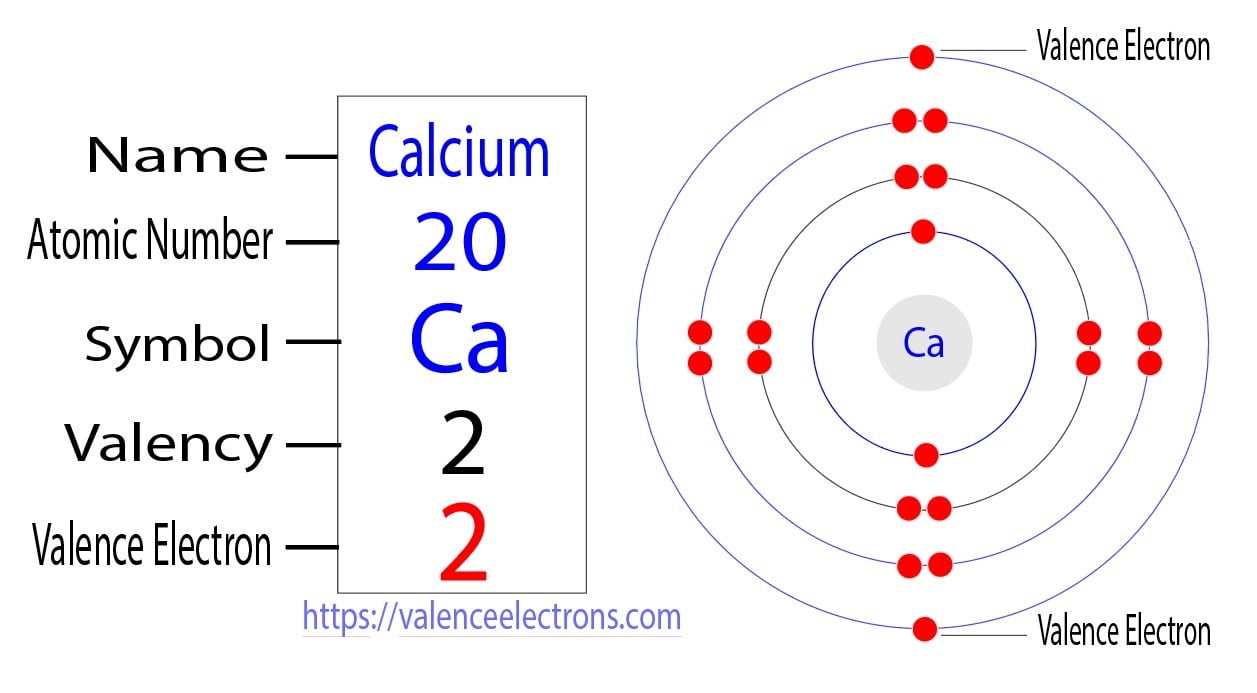
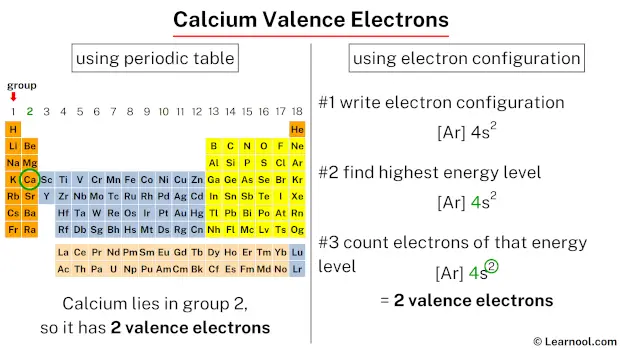
Calcium has the electron configuration [Ar] 4s2, so a neutral calcium atom has two valence electrons in the 4s orbital.
For students learning chemistry in the United States, the fastest way to understand calcium's valence electron configuration is to start with its atomic number. Calcium, written as Ca on the periodic table, has atomic number 20, meaning a neutral calcium atom contains 20 electrons. Its electrons are arranged as 1s2 2s2 2p6 3s2 3p6 4s2, or more simply [Ar] 4s2.
The two electrons in the outermost occupied principal energy level, n = 4, are calcium's valence electrons. Because calcium is a Group 2 alkaline earth metal, it commonly loses these two electrons to form the Ca2+ ion. Understanding this connection between electron configuration, valence electrons, and ion formation makes calcium a useful example for learning chemical bonding.
Source: valenceelectrons.com
What Is the Valence Electron Configuration of Calcium?
The valence electron configuration of calcium is 4s2. This notation shows that calcium has two electrons occupying the 4s subshell in its outermost occupied principal energy level.
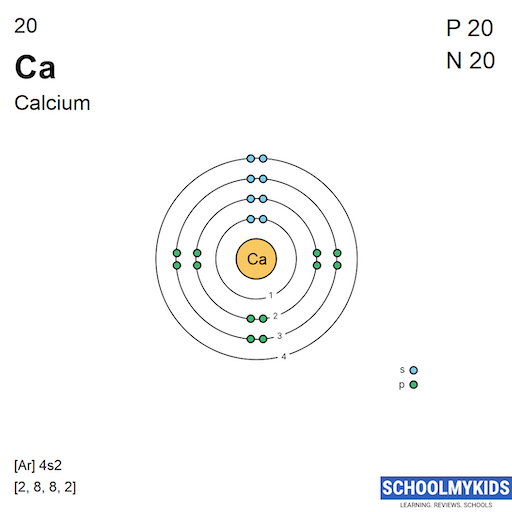
Calcium has 20 electrons in a neutral atom. Filling the orbitals according to the standard Aufbau order gives 1s2 2s2 2p6 3s2 3p6 4s2. The first 18 electrons correspond to the electron configuration of argon, so the shorter notation is [Ar] 4s2.
The 4s2 portion is the key part when discussing calcium's valence electrons. Both 4s electrons are available to participate in chemical behavior, particularly when calcium forms compounds by losing electrons.
Source: guide-scientific.com
Element
Calcium, represented by the symbol Ca.
Atomic number
20, which means a neutral calcium atom contains 20 protons and 20 electrons.
Valence configuration
4s2.
Number of valence electrons
Two.
Common ion
Ca2+, formed when calcium loses its two outermost electrons.
Why Does Calcium Have Two Valence Electrons?
Calcium belongs to Group 2 of the periodic table. Elements in this group have an outer electron configuration of ns2. For calcium, the relevant principal energy level is n = 4, so the configuration becomes 4s2.
The two electrons in 4s are the outermost electrons of a neutral calcium atom. This is why calcium is classified as an element with two valence electrons.
Group 2 pattern
Calcium follows the general Group 2 valence pattern ns2.
Outer shell
The highest occupied principal energy level is n = 4.
Calcium Electron Configuration Step by Step
To write the electron configuration of calcium, begin with its atomic number, 20. A neutral calcium atom therefore needs 20 electrons arranged among atomic orbitals.
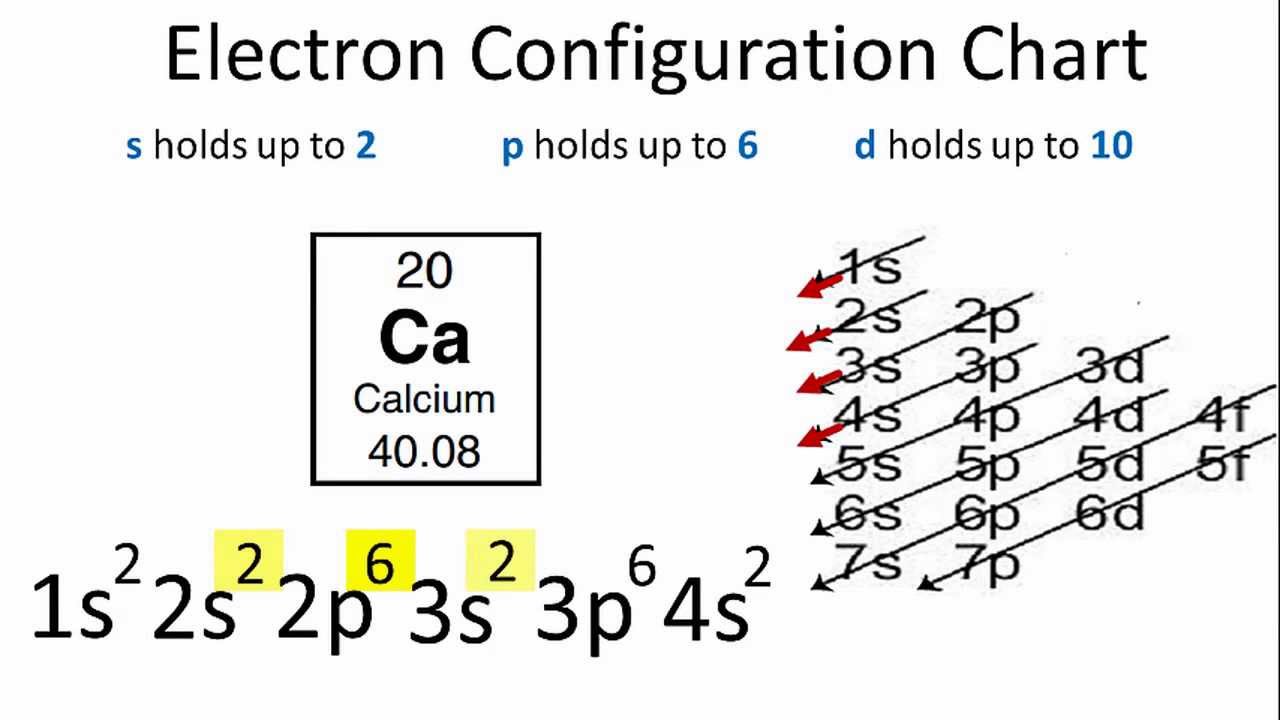
The orbitals fill in this commonly used sequence: 1s, 2s, 2p, 3s, 3p, and 4s. Each s subshell can hold a maximum of two electrons, while each p subshell can hold up to six electrons.
Following the filling order produces the complete configuration 1s2 2s2 2p6 3s2 3p6 4s2. Counting the superscripts gives 20 electrons in total.
Source: iperiodictable.com
1s2
The first two electrons occupy the 1s orbital.
2s2 2p6
The second principal energy level contains eight electrons.
3s2 3p6
The third principal energy level contains eight electrons in the ground-state configuration.
4s2
The final two electrons occupy the 4s subshell and are calcium's valence electrons.
Full Electron Configuration
The full ground-state electron configuration of neutral calcium is 1s2 2s2 2p6 3s2 3p6 4s2. This form displays every occupied subshell and is useful when practicing electron configuration rules.
Electron count
2 + 2 + 6 + 2 + 6 + 2 = 20 electrons.
Ground state
The configuration describes neutral calcium in its lowest-energy electron arrangement.
Noble Gas Shorthand
The first 18 electrons of calcium have the same configuration as argon. Because argon has atomic number 18, its symbol, [Ar], can replace 1s2 2s2 2p6 3s2 3p6. Calcium can therefore be written as [Ar] 4s2.
Noble gas notation is especially convenient because it highlights the electrons added after the preceding noble gas. For calcium, those two added electrons are exactly the valence electrons.
Preceding noble gas
Argon, with atomic number 18.
Shorthand
[Ar] 4s2.
Calcium Valence Electrons and the Periodic Table
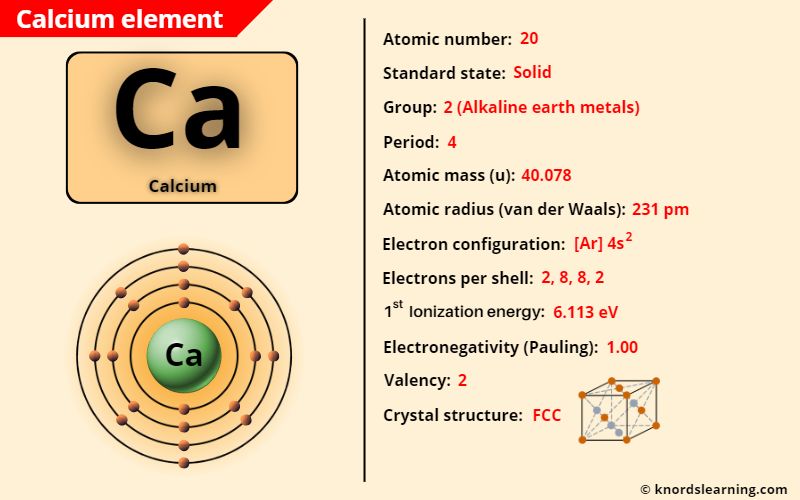
Calcium's position on the periodic table provides a quick way to predict its valence electron count. Calcium is located in Group 2 and Period 4. For the main-group elements, the group position is closely related to the number of electrons in the outer shell.
Because calcium is in Group 2, it has two electrons in its outermost shell. Its Period 4 position tells us that the highest occupied principal energy level in the neutral ground-state atom is n = 4.
This periodic-table pattern also helps explain calcium's typical chemical behavior. Losing two electrons leaves calcium with the stable electron configuration of argon.
Source: animalia-life.club
Group
Group 2, the alkaline earth metals.
Period
Period 4.
Outer subshell
4s.
Valence electrons
Two.
Calcium as a Group 2 Element
Group 2 elements have two electrons in their outermost s subshell. Calcium follows this pattern with 4s2. The same general pattern appears in other alkaline earth metals, although their principal energy levels differ.
The two outer electrons are significant because removing them produces a calcium ion with a closed-shell configuration.
Chemical tendency
Calcium commonly loses two electrons rather than gaining six electrons.
Resulting charge
Loss of two electrons produces a 2+ ionic charge.
Calcium Orbital Diagram and Valence Electrons
An orbital diagram represents electrons with arrows placed inside orbital boxes. For calcium, the occupied subshells are 1s, 2s, 2p, 3s, 3p, and 4s. The two 4s electrons occupy the same 4s orbital with opposite spins in the ground state.
A simplified orbital representation is useful because it shows not only how many electrons are present but also how they are distributed among orbitals. The 4s orbital contains a paired set of electrons, represented as opposite-spin arrows.
The 3d subshell is empty in the ground-state electron configuration of neutral calcium. This point can prevent a common mistake: calcium's valence configuration is 4s2, not 3d2.
Source: ar.inspiredpencil.com
4s orbital
Contains two electrons in neutral calcium.
3d orbital
Empty in the ground-state configuration of neutral calcium.
Valence electrons
The two 4s electrons are the outermost electrons.
Why Is 4s2 Written Before 3d?
For neutral calcium in its ground state, the 4s subshell is occupied before the 3d subshell begins to fill. Calcium has only 20 electrons, so its configuration ends at 4s2. The next element, scandium, begins filling the 3d subshell.
Electron configurations should be written according to the actual ground-state arrangement rather than by assuming that every available subshell must contain electrons.
Calcium
Ends with 4s2.
Next element
Scandium begins the transition-metal series and introduces a 3d electron in its ground-state configuration.
Lewis Dot Structure of Calcium
The Lewis dot symbol for a neutral calcium atom uses the chemical symbol Ca with two dots representing its two valence electrons. The two dots can be placed around the symbol according to standard Lewis representation conventions.
Lewis dot structures focus on valence electrons rather than showing the complete electron configuration. For calcium, the two dots correspond to the 4s2 electrons in the ground-state atom.
When calcium forms a typical ionic compound, it loses both valence electrons. The resulting Ca2+ ion is therefore represented without valence-electron dots in the simple Lewis ionic picture.
Source: periodictable.me
Neutral calcium
Ca with two valence-electron dots.
Calcium ion
Ca2+ after the atom loses its two valence electrons.
Purpose
The Lewis symbol emphasizes the outer electrons involved in chemical bonding.
How Calcium Forms the Ca2+ Ion
Calcium commonly forms Ca2+ by losing its two 4s electrons. A neutral calcium atom begins with 20 electrons. After losing two electrons, the ion has 18 electrons.
The resulting Ca2+ ion has the electron configuration 1s2 2s2 2p6 3s2 3p6, which is equivalent to [Ar]. This gives the ion a filled outer principal energy level in the simplified shell model.
The electron loss can be represented as Ca → Ca2+ + 2e−. This equation shows that calcium loses two electrons and becomes a positively charged ion.
Source: ar.inspiredpencil.com
Neutral calcium
20 electrons with the configuration [Ar] 4s2.
Electron loss
Two 4s electrons are removed.
Calcium ion
Ca2+ contains 18 electrons and has the configuration [Ar].
Why Does Calcium Lose Two Electrons?
Calcium has two electrons beyond the closed-shell configuration of argon. Removing those two outer electrons produces the lower-electron-count configuration [Ar]. In typical ionic compounds, this electron transfer is associated with formation of the Ca2+ cation.
The phrase stable electron configuration is useful as a simplified description of the resulting closed-shell arrangement. Actual chemical behavior depends on the complete bonding environment, so electron configuration should not be treated as the only factor determining compound properties.
Starting configuration
[Ar] 4s2.
After losing two electrons
[Ar].
Common Mistakes in Calcium Electron Configuration
Most errors with calcium's electron configuration come from confusing the full configuration with the valence configuration or from assigning electrons to the wrong subshell. Checking the atomic number and counting the electrons in the written configuration can catch many of these mistakes.
Another common error is writing calcium as [Ar] 3d2. Neutral calcium does not have two 3d electrons in its ground state. Its configuration ends with [Ar] 4s2.
Students can also confuse calcium's neutral atom with Ca2+. The neutral atom has 20 electrons and two valence electrons, while Ca2+ has 18 electrons and the electron configuration [Ar].
Source: learnool.com
Mistake: [Ar] 3d2
For ground-state neutral calcium, the correct shorthand is [Ar] 4s2.
Mistake: three valence electrons
Calcium has two valence electrons, not three.
Mistake: Ca and Ca2+ are identical
They have different electron counts and different electron configurations.
Mistake: ignoring atomic number
Atomic number 20 provides the electron count for a neutral calcium atom.
A Quick Verification Method
When you finish writing a calcium electron configuration, add the superscript numbers. For 1s2 2s2 2p6 3s2 3p6 4s2, the total is 20. Then identify the highest occupied principal energy level. Here it is n = 4, and the electrons in that outer level are 4s2.
Step 1
Confirm that the atom is neutral and therefore has 20 electrons.
Step 2
Add all superscripts to verify that the configuration contains 20 electrons.
Step 3
Find the highest occupied principal energy level, n = 4.
Step 4
Identify the outer electrons as 4s2.
Frequently Asked Questions
Q
How many valence electrons does calcium have?
A neutral calcium atom has two valence electrons. Its electron configuration is [Ar] 4s2, and the two electrons in the 4s subshell are the outermost electrons.
Q
What is the valence electron configuration of calcium?
The valence electron configuration of calcium is 4s2. The complete electron configuration is 1s2 2s2 2p6 3s2 3p6 4s2.
Q
What is the shorthand electron configuration of calcium?
The shorthand electron configuration of neutral calcium is [Ar] 4s2. The [Ar] represents the first 18 electrons, while 4s2 represents the final two electrons.
Q
What is the electron configuration of Ca2+?
Ca2+ has 18 electrons because neutral calcium loses two electrons. Its electron configuration is 1s2 2s2 2p6 3s2 3p6, or simply [Ar].
Q
Why does calcium have two valence electrons?
Calcium is a Group 2 element with the outer electron configuration 4s2. Therefore, its outermost occupied energy level contains two electrons.
Q
Is calcium's electron configuration [Ar] 3d2?
No. The ground-state electron configuration of neutral calcium is [Ar] 4s2. The 3d subshell is not occupied in the ground state of neutral calcium.
✦ Wrapping Up
Conclusion
The valence electron configuration of calcium is 4s2, and a neutral calcium atom has two valence electrons. Calcium's full electron configuration is 1s2 2s2 2p6 3s2 3p6 4s2, while its noble gas shorthand is [Ar] 4s2.
These two outer electrons explain an important part of calcium's chemistry. Calcium commonly loses both electrons to form Ca2+, leaving the ion with the [Ar] electron configuration. The connection between calcium's periodic-table position, 4s2 configuration, two valence electrons, and Ca2+ ion formation provides a simple framework for solving many introductory chemistry questions.
💡 Key Takeaway
For a quick exam check, remember this sequence: calcium has atomic number 20, its shorthand configuration is [Ar] 4s2, it has two valence electrons, and it commonly forms Ca2+ by losing those two electrons.





No comments