What is Electric Current
Have you ever wondered what actually powers your phone, lights up your home, or runs your computer? The secret behind all these everyday miracles is something called electric current.
But what exactly is electric current, and why should you care about it? Understanding electric current is like unlocking the basic language of electricity—a force that surrounds and shapes so much of your daily life. You’ll discover the simple truth about electric current, how it flows, and why it matters to you.
By the end, you’ll see electricity in a whole new light, making you more confident in how you use and think about the devices that keep your world running. Keep reading—you’re about to make electric current easy and clear!
Definition Of Electric Current
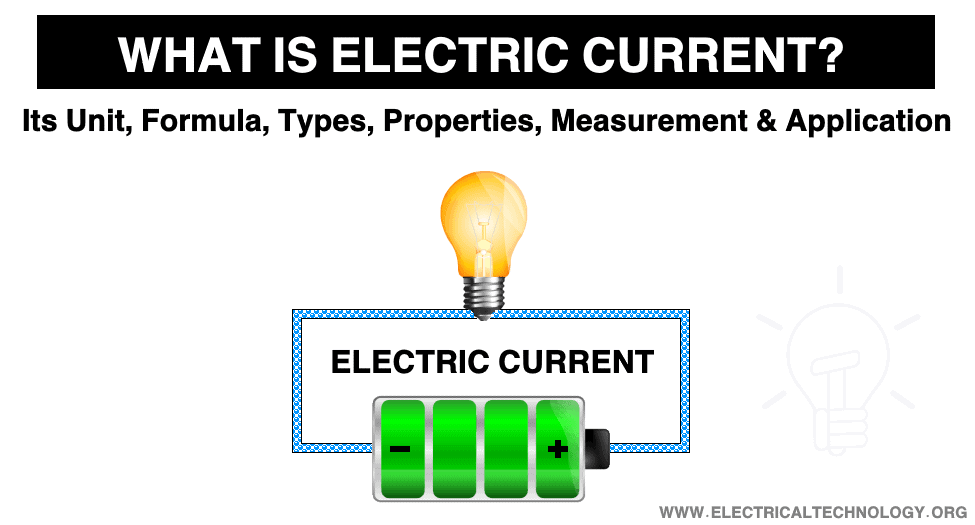
Electric current is the flow of electric charge through a material. It is what powers our homes and devices. Without electric current, many modern conveniences would not work.
Electric current moves in a specific direction through conductors like wires. Understanding this flow helps us use electricity safely and efficiently.
Charge Flow And Charge Carriers
Electric current is caused by the movement of charged particles. These particles are called charge carriers. In metals, electrons are the main charge carriers.
In some liquids and gases, ions carry the charge instead. The flow of these charge carriers creates the electric current. The faster they move, the stronger the current.
Units Of Measurement
The unit for electric current is the ampere, often shortened to amp or A. One ampere equals one coulomb of charge passing a point per second. Measuring current helps us control electrical devices properly.
Ammeters are tools used to measure electric current. Keeping current within safe limits prevents damage and hazards.
Credit: www.electricaltechnology.org
Direction Of Current
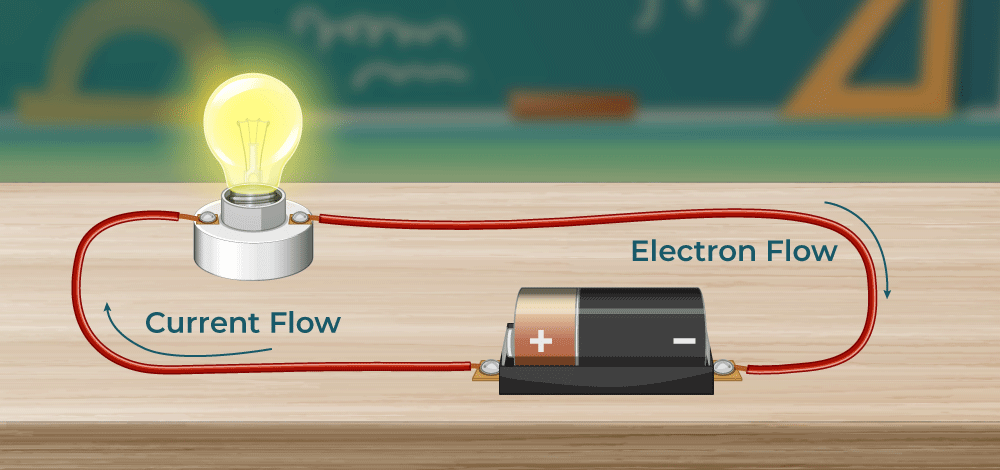
The direction of electric current is important in understanding how electricity works. It shows us which way the electric charge moves in a circuit. There are two main ideas about this direction. One is called conventional current, and the other is electron flow. Both explain current flow but in opposite directions.
Conventional Current
Conventional current is the older and more common way to show current direction. It assumes that current flows from the positive side to the negative side of a power source. This idea started before scientists fully understood electrons. Most circuit diagrams and textbooks still use this direction. It helps to keep things simple in learning and designing circuits.
Electron Flow
Electron flow is the real movement of electric charge. Electrons are tiny particles with a negative charge. They move from the negative side to the positive side of the power source. This is the true direction of electric current in metals and wires. Electron flow is opposite to conventional current. Knowing this helps scientists and engineers work with electricity more accurately.
Types Of Electric Current
Electric current moves in different ways depending on its type. Understanding these types helps explain how electricity powers devices. Two main types exist: Direct Current (DC) and Alternating Current (AC).
Direct Current (dc)
Direct Current flows in one steady direction. It moves from the negative to the positive terminal. Batteries and solar cells produce DC power. Devices like flashlights and laptops often use DC. This type of current is simple and constant. It is ideal for low-voltage electronics and charging applications.
Alternating Current (ac)
Alternating Current changes direction periodically. It reverses its flow many times per second. Most household electricity uses AC power. This current type travels efficiently over long distances. It powers homes, offices, and large appliances. AC allows voltage to be easily increased or decreased with transformers.
Credit: www.geeksforgeeks.org
Electric Current Formula
The electric current formula is a simple way to find the flow of electricity in a circuit. It helps measure how much charge moves through a wire in a given time. Understanding this formula is important for anyone learning about electricity. The formula connects current, voltage, and resistance, which are key parts of an electric circuit.
Current Calculation
Electric current is the rate of charge flow. It is measured in amperes (A). The formula to calculate current is:
Here, I stands for current, Q is the charge in coulombs, and t is the time in seconds. This means current is the amount of charge passing through a point each second.
Relation With Voltage And Resistance
Voltage and resistance affect electric current. Ohm’s Law shows this relation:
In this formula, V is voltage in volts, and R is resistance in ohms. Voltage pushes the charge, and resistance slows it down. When voltage increases, current rises. When resistance increases, current falls.
Conditions For Current Flow
Electric current flows only under specific conditions. Understanding these conditions helps explain how electricity works in everyday devices. The movement of electric charges depends on the circuit setup and the energy source. Without the right conditions, current cannot flow, and electrical devices will not operate.
Closed Circuit Requirement
For electric current to flow, the circuit must be closed. A closed circuit means the path is complete and unbroken. Electrons need a continuous loop to move from the power source and back. Any break or gap stops the current immediately. Switches control this by opening or closing the circuit.
Voltage Source Role
A voltage source pushes the electric charges through the circuit. It provides the energy needed for current flow. Batteries and generators are common voltage sources. Without a voltage source, charges do not move, and no current flows. The higher the voltage, the stronger the push for current.
Current In Different Materials
Electric current behaves differently depending on the material it passes through. Each material allows charged particles to move in unique ways. Understanding these differences helps explain how electricity works in daily life. Conductors, semiconductors, and insulators all interact with current differently. Let’s explore how current flows in metals and liquids.
Metals And Electron Movement
Metals carry electric current through free electrons. These electrons move easily because metal atoms have loosely held outer electrons. When a voltage is applied, electrons flow through the metal wire. This flow creates the electric current. Metals like copper and aluminum are good conductors. Their structure allows electrons to move freely and quickly. This is why metals are widely used in electrical wiring and devices.
Current In Liquids And Electrolytes
Liquids conduct electricity differently from metals. Pure water does not conduct well because it lacks charged particles. Electrolytes, such as saltwater, contain ions that carry electric charge. These ions move toward electrodes of opposite charge. This movement forms an electric current in the liquid. Many batteries and electrochemical cells rely on this principle. Current flow in liquids depends on the concentration of ions and the liquid’s nature.
Controlling Electric Current
Controlling electric current is essential for safe and efficient use of electrical devices. Without control, electric current can cause damage or stop devices from working properly. Managing current means adjusting its flow to match the needs of different circuits and components. Simple tools and principles help us keep electric current at the right level.
Role Of Resistance
Resistance is a property that slows down electric current. It acts like a narrow path for water, limiting how much can flow. Higher resistance means less current passes through. Resistance protects circuits by preventing too much current from flowing. It also helps convert electrical energy into heat or light in many devices.
Use Of Resistors
Resistors are components designed to add resistance to a circuit. They control the current by reducing its flow to safe levels. Resistors come in many sizes and strengths, depending on the circuit needs. They help protect sensitive parts and ensure devices work correctly. Using resistors is a simple way to manage electric current effectively.
Effects Of Electric Current
Electric current is more than just a flow of electrons. It causes various effects that impact our daily lives and technology. These effects reveal how electric current interacts with materials and forces around it. Understanding these effects helps us use electricity safely and efficiently.
Magnetic Field Generation
Electric current creates a magnetic field around the conductor. This happens because moving charges produce magnetism. The magnetic field forms circular lines around the wire. The strength of this field depends on the amount of current and the shape of the wire.
This magnetic effect is the basis for many devices. It allows us to control magnets with electricity. The field can attract or repel certain materials. It also helps in creating motion in machines like motors.
Practical Applications
The effects of electric current have many practical uses. Electric motors turn electrical energy into mechanical power. This power drives fans, pumps, and vehicles. Electromagnets use current to lift heavy metal objects in scrapyards.
Electric current also heats devices like toasters and irons. This heat comes from resistance in the wires. It helps cook food or press clothes. Light bulbs glow when current passes through them, giving us light.

Credit: www.youtube.com
Frequently Asked Questions
What Is A Simple Electric Current?
A simple electric current is the steady flow of charged particles, like electrons, through a conductor. It measures electric charge passing per second.
Which Is The Best Definition Of An Electrical Current?
Electrical current is the net flow of electric charge through a conductor per unit time. It measures charge movement.
What Is The Simple Definition Of Current?
Current is the flow of electric charge through a conductor, measured in amperes (amps). It moves charged particles like electrons.
What Is Electric Current Grade 8?
Electric current is the flow of electric charge through a conductor. It moves electrons in wires and is measured in amperes (amps).
Conclusion
Electric current is the flow of tiny charged particles. It moves through wires and many materials. This flow powers devices and lights up homes. Understanding current helps explain how electricity works. It plays a key role in daily life. Simple facts about current make science clearer.
Keep exploring to learn more about electricity.


No comments