Electron Configuration of Antimony
Are you curious about what makes antimony tick at the atomic level? Understanding the electron configuration of antimony (Sb) is key to unlocking its unique chemical behavior and properties.
Whether you're a student tackling chemistry homework or just passionate about the elements, knowing how antimony’s electrons are arranged can give you a clear edge. You’ll discover a simple breakdown of antimony’s electron configuration, why it matters, and how it influences everything from its reactivity to its place in the periodic table.
Stick with me, and you’ll gain a solid grasp of this fascinating element—no complicated jargon, just straightforward explanations that make learning easy and engaging.
Credit: www.chegg.com
Atomic Structure Of Antimony
Antimony is a fascinating element with a unique atomic structure. Its atomic arrangement defines many of its chemical properties. Understanding its electron distribution helps explain its behavior in reactions.
The atomic structure of antimony includes protons, neutrons, and electrons arranged in specific shells and subshells. This structure determines how antimony interacts with other elements.
Electron Shells And Subshells Of Antimony
Antimony has 51 electrons. These electrons fill different shells around the nucleus. Each shell contains subshells labeled s, p, d, and f. Electrons fill these subshells in a set order.
In antimony, the electrons fill up to the 5th shell. The outermost shell contains the valence electrons responsible for chemical bonding. The distribution of electrons across these shells defines antimony’s place in the periodic table.
Electron Configuration Notation Of Antimony
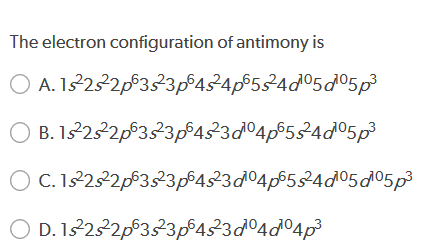
The electron configuration of antimony is written as [Kr] 4d10 5s2 5p3. This notation shows the arrangement of electrons in energy levels and subshells.
The [Kr] represents the noble gas krypton, a core that simplifies the configuration. Following this, 4d10 means ten electrons fill the 4d subshell. The 5s and 5p subshells hold the outermost electrons.
Significance Of Valence Electrons In Antimony
Antimony has five valence electrons in the 5s and 5p subshells. These electrons mainly determine its chemical properties. They participate in forming bonds with other atoms.
The three electrons in the 5p subshell make antimony reactive. The 5s electrons add stability. This balance gives antimony unique characteristics in compounds.
Electron Shells And Subshells
Understanding the electron shells and subshells of antimony helps explain its chemical behavior. Electrons arrange themselves in layers around the nucleus. These layers are called shells. Each shell contains smaller parts called subshells. Electrons fill these subshells in a specific order. This order affects how antimony interacts with other elements.
Electron Shells Of Antimony
Antimony has five electron shells. Each shell is numbered from 1 to 5, starting from the center. The first shell holds up to 2 electrons. The second and third shells can hold more electrons, up to 8 and 18 respectively. The fourth shell also holds 18 electrons. The fifth shell contains fewer electrons for antimony, as it is not fully filled.
Subshells In Antimony's Electron Shells
Each shell has different types of subshells. These are labeled s, p, d, and f. The s subshell holds 2 electrons. The p subshell can hold 6 electrons. The d subshell holds up to 10 electrons. The f subshell can hold 14 electrons. Antimony's electron configuration includes s, p, and d subshells, but no f subshell electrons.
Filling Order Of Antimony’s Subshells
Electrons fill subshells following a specific sequence. This order is based on energy levels. Lower energy subshells fill first. For antimony, electrons fill the 1s subshell first. Then they fill 2s, 2p, 3s, 3p, 4s, 3d, 4p, 5s, 4d, and finally 5p subshells. This order gives antimony its unique electron structure.
Ground State Configuration
The ground state configuration of an element shows how electrons fill the atomic orbitals. It reveals the most stable arrangement of electrons in an atom. For antimony, this arrangement is important to understand its chemical behavior.
Antimony has an atomic number of 51. This means it has 51 electrons orbiting its nucleus. These electrons spread over different energy levels and sublevels.
Electron Configuration Notation For Antimony
The electron configuration of antimony starts with the noble gas krypton as a core. Then, it continues filling the 4d, 5s, and 5p orbitals. The full ground state configuration is written as:
This notation indicates that after krypton’s electrons, antimony adds 10 electrons in 4d, 2 in 5s, and 3 in 5p orbitals.
Distribution Of Electrons In Sublevels
Electrons fill sublevels in order of increasing energy. The 4d sublevel holds 10 electrons, fully occupied. The 5s sublevel has 2 electrons, also fully filled. The 5p sublevel contains 3 electrons, partially filled.
This distribution affects antimony’s chemical properties and bonding patterns.
Significance Of Ground State Configuration
The ground state configuration helps predict antimony’s reactivity. It shows valence electrons in the 5s and 5p orbitals. These electrons participate in chemical bonds. Understanding this guides chemists in studying antimony’s compounds.

Credit: www.vedantu.com
Electron Configuration Notation
The electron configuration notation shows how electrons arrange around an atom's nucleus. It uses numbers, letters, and superscripts to describe electron positions in shells and subshells. This notation helps understand an element's chemical behavior and properties.
For antimony, the electron configuration reveals the distribution of its 51 electrons in different energy levels. The notation starts with the closest electrons to the nucleus and moves outward, filling each subshell in order of increasing energy.
What Is Electron Configuration Notation?
Electron configuration notation represents electrons in shells and subshells. Numbers show energy levels, letters represent subshell types (s, p, d, f), and superscripts indicate electron count in each subshell. This system simplifies complex atomic structures.
Electron Configuration Notation Of Antimony (sb)
Antimony’s electron configuration is [Kr] 4d10 5s2 5p3. The symbol [Kr] stands for the noble gas krypton, which covers electrons 1 to 36. After krypton, antimony has 4d, 5s, and 5p electrons filling its outer shells.
Importance Of Using Noble Gas Core In Notation
Using the noble gas core shortens the notation by replacing inner electrons with a symbol. It makes reading and writing electron configurations easier. For antimony, [Kr] represents 36 electrons, so only the outer 15 electrons are shown fully.
Valence Electrons In Antimony
Understanding valence electrons in antimony reveals its chemical behavior. Valence electrons are the outermost electrons in an atom. They determine how the atom bonds with others. Antimony, with atomic number 51, has unique valence electron properties. These electrons influence its reactivity and placement in the periodic table.
Electron Shells And Subshells Of Antimony
Antimony’s electrons fill several shells and subshells. The core electrons fill inner shells, while valence electrons occupy outer shells. Its electron configuration ends in the 5th shell. The subshells involved are 5s and 5p. These outer subshells hold the valence electrons critical for bonding.
Number Of Valence Electrons In Antimony
Antimony has five valence electrons. These electrons are in the 5s and 5p orbitals. Specifically, two electrons are in the 5s subshell. Three electrons occupy the 5p subshell. Together, they form the valence shell responsible for chemical reactions.
Role Of Valence Electrons In Chemical Properties
Valence electrons in antimony affect its reactivity and bonding style. They allow antimony to form three covalent bonds typically. These electrons also contribute to its metallic and nonmetallic traits. The electron arrangement explains its place in group 15 of the periodic table.

Credit: www.youtube.com
Antimony In The Periodic Table
Antimony is a chemical element with the symbol Sb. It belongs to the p-block of the periodic table. This element is part of group 15, also known as the nitrogen family.
Located in period 5, antimony has unique properties. It shares characteristics with metals and nonmetals. This makes it a metalloid.
Position And Group
Antimony is in group 15, along with nitrogen, phosphorus, arsenic, and bismuth. These elements have five electrons in their outer shell. This group is sometimes called the pnictogens.
Period And Block
Antimony lies in period 5, which means it has electrons in five energy levels. It belongs to the p-block because its outer electrons occupy p orbitals. The p-block elements often have varied chemical behavior.
Atomic Number And Symbol
Antimony's atomic number is 51. This number shows the total protons in its nucleus. The symbol Sb comes from the Latin word "stibium," used in ancient times.
Physical And Chemical Traits
Antimony appears bluish-gray and is brittle. It is a poor conductor of electricity compared to metals. Chemically, it can form compounds with various elements.
Comparison With Neighboring Elements
Comparing the electron configuration of antimony with its neighboring elements reveals interesting patterns. Antimony, with the atomic number 51, sits between tin (Sn) and tellurium (Te) in the periodic table. Each of these elements shows unique electron arrangements that influence their chemical behavior.
Studying these differences helps us understand periodic trends. It also clarifies why these elements have distinct properties despite being close on the table.
Electron Configuration Of Tin (sn)
Tin has an atomic number of 50. Its electron configuration ends at 5s² 4d¹⁰ 5p². Tin fills the 5p orbital with two electrons. This is one less than antimony’s 5p³ configuration. This difference affects tin’s bonding and reactivity.
Electron Configuration Of Antimony (sb)
Antimony’s electron configuration is [Kr] 4d¹⁰ 5s² 5p³. The three electrons in the 5p orbital give antimony its unique traits. It can form multiple bonds and exhibits semimetallic properties. The half-filled p orbital adds stability to antimony’s structure.
Electron Configuration Of Tellurium (te)
Tellurium has atomic number 52. Its electron configuration ends at 5s² 4d¹⁰ 5p⁴. It has four electrons in the 5p orbital. This extra electron compared to antimony affects tellurium’s electronegativity and chemical bonds. Tellurium behaves more like a nonmetal than antimony does.
Role Of D And F Orbitals
The role of d and f orbitals in the electron configuration of antimony is essential to understand its chemical behavior. These orbitals help shape how electrons fill in the atom beyond the basic s and p orbitals. Antimony, being a heavier element, has electrons occupying the d orbitals, which influence its properties.
Although antimony’s electron configuration mainly involves s and p orbitals, the d orbitals play a supporting role. The f orbitals, however, do not directly participate in its electron filling but affect elements nearby in the periodic table. Knowing this distinction clarifies how antimony interacts with other elements and forms compounds.
Understanding D Orbitals In Antimony
Antimony’s electrons fill the 4d orbitals before reaching the 5s and 5p orbitals. These d orbitals contain ten electrons, which add stability to the atom. They also affect the shape and size of the electron cloud around the nucleus. This influence helps determine antimony’s chemical reactivity and bonding patterns.
The Influence Of F Orbitals On Antimony
Antimony itself does not have electrons in the f orbitals. These orbitals are filled in elements with higher atomic numbers, mainly in the lanthanide and actinide series. The presence of f orbitals in nearby elements can affect the overall electron environment around antimony in complex compounds.
Why D Orbitals Matter More Than F Orbitals
In antimony, d orbitals are closer to the nucleus and have a direct effect on electron configuration. They help shield the outer electrons and influence the element’s chemical properties. Since f orbitals are absent in antimony’s ground state, they do not play a direct role in its electron arrangement.
Common Electron Configuration Mistakes
Many students and beginners make common mistakes while writing the electron configuration of antimony. These errors often come from misunderstanding the order of orbital filling or ignoring the noble gas core. Such mistakes can lead to incorrect chemical interpretations and confusion in learning. Recognizing these errors helps in learning the correct pattern easily.
Incorrect Use Of Noble Gas Core
Many forget to use the noble gas shorthand for antimony. Instead of starting with [Kr], they write out all electrons. This makes the configuration longer and harder to read. Using [Kr] simplifies the configuration and shows the core electrons clearly.
Wrong Order Of Orbital Filling
Students often list orbitals out of order. For antimony, the 5s orbital fills before 4d and 5p. Writing 5p before 5s is a common mistake. Following the Aufbau principle helps avoid this error and keeps the sequence correct.
Ignoring Electron Count
Counting the total electrons incorrectly is another issue. Antimony has 51 electrons. Some write configurations with too many or too few electrons. Double-checking the electron count ensures the configuration matches the element.
Misplacing Electrons In Subshells
Misplacing electrons in s, p, or d subshells leads to wrong configurations. For example, putting 4d electrons into 5p or vice versa. Each subshell has a fixed capacity and order. Understanding this prevents such mistakes.
Applications Linked To Electron Structure
The electron configuration of antimony plays a key role in its practical uses. This arrangement of electrons determines how antimony reacts and bonds with other elements. Understanding this helps explain why antimony is chosen for certain applications.
Antimony has electrons filling the 5s and 5p orbitals, giving it unique chemical properties. These properties make it useful in electronics, alloys, and flame retardants. The electron structure also affects its stability and conductivity.
Electron Configuration And Semiconductor Use
Antimony’s electron arrangement allows it to act as a semiconductor. It can control electrical currents in devices. This is useful in making diodes and infrared detectors. The outer electrons help form bonds essential for semiconductor behavior.
Role In Alloys And Metallurgy
The electron structure of antimony contributes to its strength when mixed with metals. It improves hardness and resistance to corrosion. Antimony is often added to lead alloys in batteries and bullets. This enhances durability and performance.
Flame Retardant Properties
Antimony compounds slow down fire spread. The electrons in antimony help form stable chemical bonds that release gases to cool flames. This makes antimony vital in plastics and textiles. Its electron configuration supports this safety function.
Frequently Asked Questions
What Electron Configuration Is 1s2 2s2 2p6 3s2 3p6 4s2 3d10?
The electron configuration 1s2 2s2 2p6 3s2 3p6 4s2 3d10 corresponds to the element Zinc (Zn). It shows filled 1s, 2s, 2p, 3s, 3p, 4s, and 3d orbitals.
Which Element Has The Electron Configuration 1s 2 2s 2 2p 6 3s 2 3p 6 4s 2 3d 5?
The element with electron configuration 1s² 2s² 2p⁶ 3s² 3p⁶ 4s² 3d⁵ is manganese (Mn).
What Is The 2 8 8 18 18 32 Rule?
The 2 8 8 18 18 32 rule describes the maximum electron capacity in successive atomic shells. It guides electron arrangement in atoms.
What Is The Electron Configuration Of Sb 51?
The electron configuration of antimony (Sb, atomic number 51) is [Kr] 4d¹⁰ 5s² 5p³. It fills up to the 5p orbital.
Conclusion
Understanding the electron configuration of antimony helps explain its chemical behavior. Antimony's electrons fill shells in a specific order. This arrangement affects how it bonds with other elements. Knowing this pattern makes chemistry clearer and simpler to study. Antimony belongs to the p-block and has valence electrons in the 5s and 5p orbitals.
This knowledge supports learning about its reactions and uses. Keep these basics in mind when exploring antimony further. Simple steps lead to better grasp of element properties.


No comments